
Showing posts with label Dizzy Gillespie. Show all posts
Showing posts with label Dizzy Gillespie. Show all posts
21 October 2010

06 July 2010
The King is Dead, Long Live the King
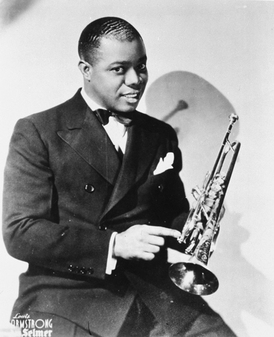
Louis Armstrong died 39 years ago today. Shortly after Armstrong died, Dizzy Gillespie penned this obituary for Satchmo (click to enlarge).
Here are the two playing Umbrella Man:Never before in the history of black music had one individual so completely dominated an art form as the Master, Daniel Louis Armstrong. His style was equally copied by saxophonists, trumpet players, pianists and all of the instrumentalists who make up the jazz picture.
One of the significant factors in his art was the ability to sing exactly as he played. Before Louis, too, the role of the trumpet was to lead. He established the trumpet as a solo instrument. The distinctive quality in his style was POWER. He was known to have hit hundreds of high C's, one after the other, each with the same level, and to end on a high F or G. This was unheard of before. His melodic concept was as near perfect as possible, his rhythm impeccable. And his humor brought joy into the lives of literally millions of people, both black and white, rich and poor.
When the State Department sent me on a cultural mission to Eastern Europe, the Middle East and South America in 1956, the band did a musical history of the various innovations that had been created in our music. Needless to say, Louis was prominently displayed.
Louis is not dead, for his music is and will remain in the hearts and minds of countless millions of the world's peoples, and in the playing of hundreds of thousands of musicians who have come under his influence.
The King Is Dead ... Long Live the King!

Image via Columbia University
30 April 2010
King Porter Stomp
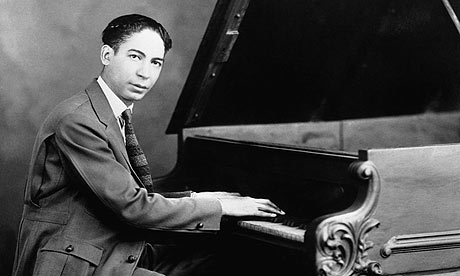
I'm pretty sure I am required by law to start with Fletcher Henderson's arrangement for the Benny Goodman Orchestra:
More after the jump:
06 April 2010
18 February 2010
Gem from the Bargain Bin
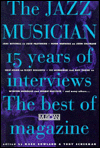 I bought one of my favorite jazz books for $4 at the bargain table at a Barnes & Noble in the late-90s. The Jazz Musician, a collection of interviews with jazz musicians from the 1980s, was compiled from the pages of Musician Magazine (not this one). I would have never found out about had I not seen it on that table; it is one reason why I continue to shop at used book stores. A few excerpts are below after the jump.
28 July 2009
George Russell

George Russell (r) with John Coltrane, via GeorgeRussell.com
Sad news this morning as the pianist, educator, and music theorist George Russell died Monday from complications from Alzheimer's disease. Russell's treatise on modal improvisation, The Lydian Chromatic Concept of Tonal Organization, published in 1953, provided the theoretical basis for the modal jazz of Miles Davis and John Coltrane. While he is perhaps best known for The Lydian Chromatic Concept, he was an important composer and musician in his own right, having written the Dizzy Gillespie classic Cubana Be Cubana Bop and led countless bands himself. If you have not checked out Ezz-Thetics
 , his 1961 album featuring Don Ellis, Eric Dolphy, and Steve Swallow, then do yourself a favor and buy it now.
Below is some audio and video of Russell for your listening pleasure...
The Jazz Video Guy brings us an an excerpt from the 1958 tv program, "The Subject is Jazz," featuring George Russell's composition and arrangement, "Stratusphunk," with Bill Evans on piano, Art Farmer, trumpet, Jimmy Cleveland, trombone, Gene Quill, alto, Ed Thigpen, drums:
An excerpt of Dizzy Gillespie's big band playing Cubano Be Cubano Bop in 1947:
Cubana Be - Dizzy Gillespie
George Russell discusses the music of Ornette Coleman with Coleman and Robert Palmer:
Also no longer with us is Merce Cunningham, the modernist choreographer. Be sure to read Ethan Iverson's brief remembrance, you'll be glad you did.
23 April 2009
Must Read
 I stumbled upon a recent Rifftides post in which Doug Ramsey reprinted an obituary he wrote for Dizzy Gillespie in the Los Angeles Times in 1993. Doug had some beautiful things to say about Diz, and I encourage you to read the full piece. In the comments, Mark Stryker of the Detroit Free Press passed a great tidbit about Diz:
 I have heard lots of personal stories from Dave Usher, one of Dizzy's closest friends whom I have gotten to know well here in Detroit. You know Dave? Dizzy's partner in Dee Gee, produced records for Argo (Moody, Jamal, etc) before entering the family oil reclamation business and then transforming it into Marine Pollution Control, one of the world's leading oil spil/disaster clean-up companies. They did the Exxon Valdez clean-up among others. Dave put Dizzy on his board and he took the responsibility seriously -- coming to Detroit to for all the annual meetings. The idea of Dizzy in that board room is such a fabulous image.Indeed.
Image via Google source:life
12 April 2009
List: 8 Essential Trumpet Solos

As a budding trumpet player in high school, I listened to a ton of trumpet solos. One of the most rudimentary steps in developing your own style as a jazz musician is to listen to as many other musicians as possible and transcribe their solos. By doing so, you improve your own ear and give yourself somewhat of a stylistic guide that serves as a jumping off point for your own voice. Below is a list of eight trumpet solos which any young musician would do well to transcribe. Some of the choices are rather obvious, and others (hopefully) are not as obvious. Feel free to let me know what I missed in the comments, the list is not meant as the be-all-end-all of jazz trumpet, but merely a starting point. The list is in relatively chronological order.
- Louis Armstrong, Wild Man Blues, from The Complete Hot Five and Hot Seven Recordings
: West End Blues gets all the attention for its divine opening cadenza, but I always preferred Wild Man Blues. Armstrong remains important to modern trumpet players both for his swagger and humanity, and he packs an abundance of both into this solo.
- Dizzy Gillespie, Shaw 'nuff, on many compilations
: Dizzy opened up new worlds for trumpet players, and his solos represent a primer on improvisation for young trumpet players. His work is an important building block for modern jazz trumpet improvisation.
- Miles Davis, Now's The Time, from almost any Charlie Parker
- Lee Morgan, Moanin', from Moanin'
: This is one of the more obvious choices on the list, but there is a reason for that. Morgan distills the entirety of hard bop into this solo, it swings violently, is drenched in the blues, but also reveals a harmonic sophistication that separated the wheat from the chaff of the genre. I could listen to this solo every day for the rest of my life and not get tired of hearing it. This solo is a necessary primer on hard bop for any young musician, trumpet player or not.
- Booker Little, Garvey's Ghost from Percussion Bitter Sweet
: Little plays outside the melody and around the changes, giving a new perspective on improvisation that bridges hard bop and free jazz.
- Miles Davis, My Funny Valentine, from The Complete Concert 1964: My Funny Valentine + Four and More
: Miles at an artistic peak. He transforms the tune with understatement.
- Freddie Hubbard, "One Finger Snap," from Empyrean Isles
:This is my favorite Hubbard solo. Hubbard had incredible chops, which makes transcribing his solos a physical as well as mental challenge. He compels you to improve your technique.
- Wynton Marsalis, Caravan from Marsalis Standard Time ~ Vol.1
: Wynton synthesizes a sizable chunk of jazz history in his earlier work, giving a good intro to neobop improvisation.
23 October 2008
Fun Fact
 What do Dizzy Gillespie and actor Rainn Wilson (who plays Dwight on The Office) have in common?
If you answered, "They are both followers of the Bahá'í Faith," then twenty points goes to you.

Program Note: I have decided to make Friday Album Cover an occasional feature. The reason is simple: I've run out of album covers that I wanted to write about, and I don't have the time right now to search for a new one every week. I could just pick random covers and write, but that isn't as interesting to me...
Onto some links...
- Jazz.com recently interviewed saxophonist and fellow Miami-transplant Marcus Strickland.
- Amazon.com is offering a free download of an ECM sampler on their mp3 site. The sampler features tracks from Pat Metheny Group, Charles Lloyd, Bill Frisell, and Chick Corea, among others. Get it while it is available.
- Nice Kenny Garrett interview at All About Jazz.
- The National Endowment for the Arts held their annual Jazz Masters ceremony, bestowing the title upon Lee Konitz, Jimmy Cobb, and Rucy Van Gelder, among others.
- R.I.P. to Neal Hefti, whose Basie charts were a favorite to play in my high school jazz band.
- Someone pointed out Heliocentric Worlds to me the other day, where I saw this awesome video of Charles Lloyd with Keith Jarrett, Cecil McBee, and Jack DeJohnette from the late sixties:
Subscribe to:
Posts (Atom)

