Showing posts with label Art Blakey. Show all posts

15 June 2010

List: Favorite Tracks From Art Blakey's 1960 Jazz Messengers

All tracks available on the sadly out of print box set from Blue Note.

Ping Pong

Afrique
Lost and Found
A Night In Tunisia

Dat Dere

Sleeping Dancer Sleep On
United
The Freedom Rider

04 March 2010

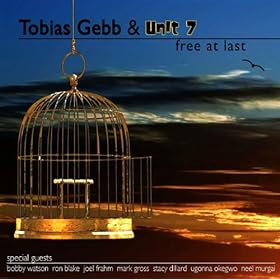
Review: Free At Last

Tobias Gebb & Unit 7
Free At Last

If there is one thing we can learn from drummer Tobias Gebb, it is that the well of bebop is not yet dry. His latest album, Free at Last, features a rotating front line reminiscent of the early-60s Jazz Messengers, while Gebb and his rhythm section have a propulsive swing reminiscent of Miles Davis' mid-50s rhythm section. From the get-go, on an up-tempo tune called Blues for Drazen, Gebb and his band show they mean business. Alto saxophonist Bobby Watson packs in a flurry of notes on the first solo, but does not overdo it. Gebb features himself on this tune as well, pulling enough music out of his snare drum alone to make Max Roach or Philly Joe Jones smile.

On Softly As In A Morning Contemplation, Gebb and company offer a fresh reading of the standard, worthy of the altered title. The tune begins on an intriguing minor vamp that flows into the melody. Gebb plays the tune more slowly than just about every other version of it that I've heard, but it works nicely. Tenor saxophonist Stacy Dillard plays a slow-burning solo that plays with modes before giving way to Watson, who once again displays ample dexterity on the horn. The solo section is so short, however, that I am left wanting more when the tune is over.

The tile track is offered as a paean to Barack Obama. Gebb writes lush harmonies for his front line on this one, punctuated by periodic obligattos from tenorman Joel Frahm. The tune, a triumphant one at its core, is also a little ambiguous at time, perhaps a reflection of Obama's road to the White House. Regardless of your feelings about Obama, the tune is simply good music.

Gebb won me over completely at the conclusion of his album with his choice to cover the Beatles' Tomorrow Never Knows, the most underrated gem of their canon. The song, comprised of a drone in C, offers many avenues of interpretation, but Gebb plays it relatively straight (though he does add a sitar to the ensemble), amplifying the undercurrent of swing found on the original. Sitarist Neel Murgai adds wonderful color to the band while not making his addition seem like a gimmick. Frahm's tenor solo is intense without losing control, drawing on Coltrane and Ayler while retaining the swing inherent throughout the album.

If I can borrow an overused phrase from sportswriting, Gebb and his bandmates play in a way that makes me think they are having a lot of fun on the bandstand. A few reviewers have already made a connection between this group and Art Blakey's Jazz Messengers, and for good reason. Aside from the superficial similarities between the two, Gebb reflects Blakey's dictum that jazz is supposed to wash away the dust from everyday life. I walked away with a smile after my first listening of Free At Last, and I can't think of a better compliment to give an album.


Track Listing: Blues For Drazen; My Love; Spitball; You Don't Know What Love Is; Bop Be Dop; Free At Last; Softly As In A Morning Contemplation; Tomorrow Never Knows
Personnel: Tobias Gebb, drums; Bobby Watson,
Mark Gross, alto saxophone; Ron Blake, Joel Frahm, Stacy Dillard, tenor saxophone; Joe Magnarelli, trumpet; Ugonna Okegwo, Neal Miner, acoustic bass; Neel Murgai, sitar; Eldad Zvulun, piano

24 February 2010

Dave Holland: A Latter Day Art Blakey

Of the generation of musicians who came of age during the development of bebop, Art Blakey is remembered as the great teacher of subsequent generations of jazz musicians. His band, The Jazz Messengers, are frequently referred to as a university of jazz in the historical literature. And his place in this slightly mythologized narrative is secure. His former sidemen, which includes Lee Morgan, Wayne Shorter, Donald Harrison, and Terence Blanchard, all credit Blakey to their developments as musicians. Blakey is the classic evangelist, as the tall tale goes:
Art was driving to an out-of-town job and passed through a village where traffic was completely tied up because of a funeral procession. Since he couldn't get past the cemetery until the service was over, he got out and listened to the eulogy. The minister spoke at length about the virtues of the deceased, and then asked if anyone had anything else to add. After a silence during which nobody spoke up, Art said, "If nobody has anything to say about the deceased, I'd like to say a few words about jazz!"1
Such was Blakey, always educating. And he is not the only musician who should be championed for his role as a bandstand professor. Dave Holland has served as a kind of Dean of Postbop for the past 30 years. His working bands, while they lack the brand name of Blakey's Messengers, have nonetheless served as a revolving door of talent which Holland nurtures. Like Blakey, Holland has an impressive record of graduates: Chris Potter, Steve Coleman, Eric Harland, and Kenny Wheeler, to name but a few.


But the analogy runs deeper than that. It is one thing to hire a bunch of up-and-coming sidemen, but quite another to let them develop as individuals while keeping your own stamp on the band at the same time. Holland and Blakey were both members of their respective rhythm sections; they could not be as overtly dominant as a front line player. Indeed, both men also recorded many original compositions written by their sidemen, and are remembered by their sidemen for their encouragement in contributing tunes to the book. But at the same time, the recorded outputs of Blakey and Holland each bear a distinctive sound. You know whose band is on the stand anytime either plays. It takes a special kind of musical leader to develop such a recognizable style with a continually changing cast of musicians passing through their bands.

Holland's recordings always seem to be well-received, but he has not quite reached the historical status of Blakey. Of course Blakey had the benefit of one of his sidemen acquiring an incredibly powerful position for mythmaking (ahem), but that's not territory I wish to cover here. Blakey also played during a time when stylistic categories within jazz were less complicated (it's much easier to approach a definition of hard bop than it is for postbop). However, if we can call the Jazz Messengers Hard Bop Academy, I think it's about time we start calling Holland's quintet the School for Postbop Studies.

Bonus material after the jump.

02 September 2009

List: Under-the-Radar Live Albums

If you want to really experience jazz, you must see it live. With that in mind, record labels have been churning out live albums at a steady pace for as long as the technology existed to make high-quality recordings of live performances. Below are some of my favorite live albums that you might not have listened to yet.

One quick qualification: I'm going for underrated and lesser-known live albums on this list. Everyone knows about the Coltrane Village Vanguard recordings and Miles at the Plugged Nickel, so why repeat what's already been written? Here is the list, in chronological order...
  1. Art Blakey: A Night at Birdland, Volumes 1 and 2 (1954). Come for the early incarnation of the Jazz Messengers, stay for the Clifford Brown. Brownie tore it up on this night in 1954, and his solos on Confirmation, Once in a While, and A Night In Tunisia are among the best he ever put on record. Not the most obscure choice to lead off the list, but it was also one of the first albums I ever bought, so I threw it in.
  2. Count Basis: Count Basie at Newport (1957). To quote Ethan Iverson, "My advice is merely: listen to it. You want to know what jazz is? This is fucking jazz." Lester Young and Jo Jones sit in for an extended guest appearance; Illinois Jacquet, Roy Eldridge, and Jimmy Rushing also make guest appearances.
  3. Miles Davis: At Newport 1958. Miles has many great live albums in his catalog, so it's no surprise this one isn't mentioned more often. However, there aren't many live offerings of Miles with Cannonball and Coltrane, so this one is essential, methinks. Throw in Bill Evans, Paul Chambers, and Jimmy Cobb, and you've got a great set. Mr. P.C.'s bass solo on Straight, No Chaser is sublime. Plus, the album cover features Miles in his sartorial splendor.
  4. Cannonball Adderley: Cannonball Adderley Quintet in San Francisco (1959). Quintessential hard bop from some of the masters. Cannon & Co.'s take on Spontaneous Combustion is some of the best 12 minutes on record.
  5. Eric Dolphy: Eric Dolphy at the Five Spot, Vol. 1 (1961). Dolphy with Booker Little, Mal Waldron, Richard Davis, and Ed Blackwell, need I say more? More than any other album on this list, I revisit this recording again and again, and each time I am amazed at the unfulfilled potential of Dolphy and Little. Who knows what heights they may have scaled had they not died too young? Volume 2 is also available.
  6. Elvin Jones: Live at the Lighthouse, Volumes 1 and 2 (1972). Perhaps if someone had given a copy of these albums to Ken Burns, he would not have alleged that jazz "went away for awhile" during the 1970s.
  7. Old and New Dreams: Playing (1980). I was made aware of this one by Destination Out, and I am better off now that I know it exists. Brilliant free jazz from Dewey Redman, Don Cherry, Charlie Haden, and Ed Blackwell.
  8. Keith Jarrett Standards Trio: Keith Jarrett at the Blue Note (1994). Jarrett's trio with Gary Peacock and Jack DeJohnette have a ton of live recordings out there, but this one is my favorite, taken from a three-night stand at New York's Blue Note in 1994. Bonus quote from Amazon reviewer Stephen A. Smith: "Keith Jarrett's trio is the McDonald's of jazz. Its greatest sales asset is consistency."
  9. Pat Metheny: Tokyo Day Trip - Live EP (2008). I've gushed about this one enough already.
These are just some of my favorites, feel free to tell me what I missed in the comments.

Extra Credit: See also the recommended recordings on last year's list of top working ensembles.


All images via jazz.com except Live at the Lighthouse via inconstantsol.blogspot.com.

06 May 2009

Review: Pass It On

Dave Holland Sextet

The other day, I realized that (the inefficacy of historical analogies aside) Dave Holland is kind of like the Art Blakey of postbop. Like Blakey, Holland has become an Old Lion who continues to surround himself with younger musicians. Not necessarily a talent scout, Holland does not discover new stars so much as create an environment to which they are attracted and in which they thrive. Holland's alumni association is quite impressive: it includes Steve Coleman, Kenny Wheeler, Robin Eubanks, Chris Potter, and Marvin "Smitty" Smith, among others. Maybe not as impressive as the volume of sidemen who passed through Art Blakey's Jazz Messengers, but about as good a roster as you will find in contemporary jazz.

Despite a constantly evolving working ensemble, Holland manages to craft albums that are both representative of his own style and refreshingly different from anything he has recorded before. That Mr. Holland has not been afforded the stature among casual jazz fans that Blakey is given is unfortunate, but I doubt he would care much for my mythologizing. I was first exposed to Holland's music in high school when I bought a copy of Prime Directive. I bought it having never heard Holland - I liked the album cover and remember the album getting a five-star review in DownBeat, so I figured it was worth the money. I was immediately taken by the record, and have since gotten my hands on much more of Holland's work.

Pass It On features Holland in a different setting than most of his albums. Instead of his normal quintet, he is joined by longtime sideman Robin Eubanks with Eric Harland on drums, Antonio Hart on saxophone, Alex Sipiagin on trumpet, and Mulgrew Miller on piano. The presence of Mulgrew is interesting, considering that Holland rarely uses a pianist, even on his big band albums, usually opting for a vibraphone instead. The album leads off with "The Sum of All Parts," a Eubanks tune that flows from an extended drums-and-trombone duet by Eubanks and Harland into a group improvisation featuring the entire front line. From here the tune commences, with snaking syncopated lines adhering into a beautiful fugue. After a minute-long melodic sequence, Holland begins a solo that is reminiscent of the highly logical melodies which grace so many of his albums. The tune is representative of the Holland's milieu: tightly-orchestrated melodies over a distinctive harmonic structure.

The remaining tunes on the album are all Holland compositions, most of which have appeared in different forms on previous Holland efforts. Nearly every one is a winner. "Modern Times" is the best of the bunch, though, featuring a very tight arrangement with wonderful timbres. Against a backdrop of Eubanks' trombone and Sipiagin's trumpet (which sounds about as mellow as a trumpet can sound), Hart and Miller unfurl a sinuous melody which on paper may look like an exercise from a method book, but on record sounds sublime.

As is so often the case, Holland's sidemen are top notch. Frequent collaborator Robin Eubanks is in his usual virtuosic form, and his command over the trombone pays vast dividends on the album. Hart and Sipiagin are two who I have not listened to much in the past, but both won me over on this album. Eric Harland is Eric Harland, and frankly, if he is good enough for Holland, Charles Lloyd, Jason Moran, and Terence Blanchard, then he is surely good enough for me. Pass It On slipped a bit under the radar last year, and did not appear on many year-end best-of lists, which is a shame. The album makes a great primer on the Dave Holland Graduate School of Jazz Performance.


Track Listing: The Sum of All Parts; Fast Track; Lazy Snake; Double Vision; Equality; Modern Times; Rivers Run; Processional; Pass It On
Personnel:
Alex Sipiagin, trumpet; Robin Eubanks, trombone; Antonio Hart, saxophone; Mulgrew Miller, piano; Dave Holland, bass; Eric Harland, drums

15 January 2009

List: 1959: Before and After

Being that 1959 saw the release of so many landmark jazz albums (Kind of Blue, Time Out, Giant Steps, The Shape of Jazz to Come, etc.), plenty of writers will be profiling the golden jubilees of all these albums throughout the year. But focusing on 1959 misses the point of that era. While 1959 was certainly a great year for jazz, the years surrounding 1959 all created their fair share of classics canonized in The Jazz Tradition. Since the late 1950s and early 1960s were a veritable golden age for jazz, when young lions like Coltrane and Coleman were reshaping the music while older stars like Ellington and Hawkins were still thriving, lets not limit ourselves to remembering 1959 as a watershed moment. Below are some great albums from 1958 and 1960 which are sometimes overshadowed by the weight of 1959.

A quick note: I am classifying these albums by the date they were recorded. Some were released the year after they were recorded, but the way things were changing in the jazz world at this time, a musician could sound much different over the space of a year (such is the case especially with John Coltrane).

1958:
  1. Bill Evans, Everybody Digs Bill Evans. Featuring an interesting album cover, Everybody Digs Bill Evans effectively introduced Evans to the jazz world just as he was to join Miles Davis' quintet at the piano chair.
  2. Cannonball Adderley, Somethin' Else. One of the classic hard bop records, Cannonball was joined by a veritable all-star band featuring Miles Davis, Art Blakey, Hank Jones, and Sam Jones. Adderley firmly established his reputation as a prominent figure in jazz with this record.
  3. Ornette Coleman, Something Else!!!!. One of the few albums in which Coleman used a piano player (Paul Bley in this case), Something Else introduced the world to Coleman before his infamous residency at New York's The Five Spot in 1959.
  4. Miles Davis, Porgy and Bess and Milestones. Porgy and Bess reinforced Miles' image as the biggest star in jazz, selling countless copies, while Milestones set the stage for 1959's Kind of Blue.
  5. Art Blakey & The Jazz Messengers, Moanin'. The title track was, in my estimation, the quintessential hard bop tune, the definitive example of the style I play when trying to explain what hard bop was.
  6. John Coltrane, Blue Train. Hard to believe Blue Note Records only got Coltrane in the studio as a leader once in his life.
  7. Sonny Rollins, Freedom Suite. Some say this is Rollins' best studio album. Hard to argue against that, but the album is also important for the brief liner notes written by Rollins which draw light to the status of African Americans in the land of the free.
1960:
  1. Miles Davis, Sketches of Spain. Though plenty of people will tell you that this is not really a jazz record, it nonetheless introduced jazz to a lot of people over the past five decades. I remember when I bought this album eight years at a music store in Toronto. When I paid for it, the cashier, a guy in a Slayer t-shirt with multiple piercings, simply said to me, "great album." This was not the kind of person you'd expect to make that comment.
  2. John Coltrane, My Favorite Things and Olé Coltrane. While My Favorite Things propelled Coltrane into stardom, Olé Coltrane is an underrated album in the Coltrane canon, featuring a young Freddie Hubbard in addition to the dueling basses of Reggie Workman and Art Davis.
  3. Ornette Coleman, Free Jazz. In which Ornette ups the ante and firmly opens Pandora's Box, cementing the enfant terrible reputation he began to earn with Something Else.
  4. Charles Mingus, Charles Mingus Presents Charles Mingus. The opening track, "Folk Forms No. 1," perfectly fuses the blues with improvised contrapuntal composition, while "Original Faubus Fables" unleashes Mingus' contempt for a segregationist Arkansas Govern0r Orval Faubus.
  5. Art Blakey & The Jazz Messengers, A Night in Tunisia and Roots & Herbs. Featuring one of the best editions of the Messengers (Lee Morgan, Wayne Shorter, Jymie Merritt, and Bobby Timmons), Blakey recorded a lot of albums in 1960. These two are my favorites of the bunch.
  6. Max Roach, We Insist! Max Roach's Freedom Now Suite. Featuring a photo of black college students at a sit-in, Roach's Freedom Now Suite presented a musical history of African Americans, featuring the vocals of Abbey Lincoln.
  7. Wes Montgomery, The Incredible Jazz Guitar of Wes Montgomery. Montgomery lays down some choice hard bop and shows all who care to listen that he is the guitar boss of the jazz community. His version of Airegin is my favorite recording of the Sonny Rollins standard.
UPDATE 1: The lists have already begun. Here's one from acompleteunknown at The Good, The Bad, and The Unknown. They've made some good choices, though I would replace Mingus' Ah Um with Blues and Roots, and would not have left off Giant Steps...

UPDATE 2: Kevin Kniestedt offers his thoughts on 1959 at Groove Notes.

06 June 2008

Friday Album Cover: A Night in Tunisia

Art Blakey & The Jazz Messengers
A Night in Tunisia

Note: I know I have been depending a bit too heavily on the Blue Note catalogue for album covers lately, so this will be the final Blue Note title for awhile.

Blue Note was responsible for a number of iconic album covers during the 1950s and 1960s, and while many remember certain albums for their photography or artwork, some albums relied solely on typography. Like other classic Blue Note albums Somethin' Else or In 'N Out, A Night in Tunisia features a simple cover consisting of the band name and album title. I always liked these covers for their understatement. With a group like Art Blakey and the Jazz Messengers, Blue Note did not need to put much on the cover to grab someone's attention at a record shop. Even so, covers like this stick out, and reflect a certain aspect of each album. In this case, the cover's vaguely African color scheme matches Art Blakey's drumming style, in which he synthesized various traditions of African drumming on his drumkit. Besides Lee Morgan's raging solo on the title track (which is quite possibly the best solo on "A Night in Tunisia" ever recorded), this album cover is something that always comes to my mind when I think of this album. No small feat for a simple text design, indeed.

Stats