Showing posts with label Vijay Iyer. Show all posts

16 March 2012

Accelerando

Vijay Iyer's latest, Accelerando, was released earlier this week. He and trio-mates Stephan Crump and Marcus Gilmore have produced a worthy follow-up to 2009's masterful Historicity. As with Historicity, Accelerando is informed by a strong rhythmic sense that hypnotic sometimes, jarring others. I've been playing it on a constant loop for the past few days, and this should persist for awhile. As with Historicity, this one will probably be at or near the top of a slew of year-end best-of lists.

Actions Speak (recorded at Winter Jazzfest 2012 in NYC):

Mmhmm:

EPK:

Image via.

23 January 2011

An Oral Tradition

A blog post from James Hale this week had me reconsidering a question which I had wanted to ponder in a blog post awhile back, but eventually decided it wouldn't be worth the effort. At Jazz Chronicles, Hale asks, "Is 'Jazz' A Dated Term?" The impetus for this question was an ostensibly heated debate at a Jazz Journalists Association conference panel entitled "The State of Jazz Journalism" (any panel titled The State of _______ foreshadows contentious debate that may not be worth it, in my opinion). Alex Rodriguez responded to the post and posted his thoughts on the subject as well. Rodriguez contends that jazz journalists and critics share a responsibility to help the jazz audience (which is "sort of like a big, dysfunctional family") achieve balance in its understanding of the music, navigating between the poles of an ahistorical and "only-historical" approach to understanding jazz. I'm left with the intention to simply ignore both poles in favor of a different analytical framework altogether.

My only reservation about writing a jazz blog is that jazz writing is surrounded by this aura of responsibility. Jazz writers and critics are assigned (or assign themselves) a gatekeeper role which is unmatched in most areas of music journalism. Classical critics are superseded in this role by repertory, rock and hip hop critics by a more easily-arrived-at definition of the musics they cover (I'm overgeneralizing here, but bear with me). I follow a lot of indie rock blogs, and I can't recall any of them ever contending with the existential dilemmas that jazz bloggers address every few months or so. To mention just one example, nobody batted an eye when Gorilla vs. Bear included albums by Beach House, Big Boi, Arcade Fire, and Erykah Badu on its 2010 albums of the year list, even though those four artists occupy vastly different corners of the music world. I can't think of any jazz blog that included nonjazz on its year-end list (even my own list was divided into jazz and nonjazz). What strikes me about this is that probably not many people would mind if someone did this, but jazz bloggers effectively policed themselves, driven by the self-imposed responsibility to promote jazz ahead of other types of music (ostensibly because jazz is always dying, or at best, holding steady). The irony here, of course, is that the jazz world is such a complex ecosystem, a place where Wynton Marsalis, the Robert Glasper Experiment, and any number of swing, traditional jazz/Dixieland, postbop, neobop, acid jazz, and jazz-rock artists can coexist on a single record-store shelf. Adding a layer of segregation to year-end lists seems arbitrary to a silly degree.

But I digress. On the question of jazz being an outdated term or an inadequate genre signifier, I must confess that the word has a continually decreasing utility to me except as a quick and dirty signifier when people ask me what kind of music I like. When I reply "jazz," the conversation never goes in the same direction, because the fact is, stories of the death of jazz to the contrary, most people know what jazz is, and a surprising number of them have at least some jazz artist they can count among their favorite musicians, be it a singer like Nina Simone or Billie Holiday, a deceased legend like Miles Davis or Charlie Parker, or a current act like Medeski Martin and Wood or Esperanza Spaulding. This is because jazz remains an oral history with many branches, one with the "only-historical" approach to understanding the music already incorporated into individual artists' personalities and musical background. It may not be immediately obvious to everyone who hears the music (indeed, you can't really hear jazz until you've listened to a lot of it first).

Indeed, Rodriguez makes this point when he champions Jason Moran, whose music "starts from a historical place." Moran is not the only artist whose music is historicized. In a recent interview, Vijay Iyer (who titled a recent album Historicity, in case you were wondering how he grounded his approach) said of jazz:
I don't think of it as a style even. I think of it as a community of people who are invested in it. And I also think of it as a body of knowledge. You can say it's a history of ideas, and also, a history of actions. I think part of what's happened is that its reason for existing has transformed in terms of who's involved and why.
I am tempted to block-quote his entire answer, but he goes into a lot of detail, so I'll paraphrase here. Iyer notes that because the socio-economic circumstances upon which jazz was built have changed (i.e. jazz musicians for the most part no longer come from an oppressed minority whose avenues for artistic self expression were limited by society), jazz itself has changed, and has grown and diversified to the point that the word cannot contain the music anymore. But even still, jazz musicians are still striving towards an expression of the self that feels "in its own small way impossible." For Iyer, this is connected to his own status as a man born from first-generation Indian immigrants, creating a new identity of the South Asian-American jazz musician. For someone else, there is another identity to invent. Because jazz is a music of invention, as time moves on the inventions multiply into a fractal of multitudes which may not all sound alike, but nonetheless remain jazz. They are born into the same tradition, but take it places that make sense to them.

I am reminded of what Esperanza Spalding told Anthony Dean-Harris in an interview last year:

We need all the aspects of it [jazz] and that’s okay. We need the Wynton Marsalis and we need the Anthony Braxton and we need a Chris Botti and we need Christian Scott. We need a Ledisi and we need a Rachelle Ferrell. We need everything... We need it all because that word doesn’t belong to anybody anymore. It’s become so broad that to me the only element of that word that has any meaning universally is just improvisation. Jazz can be anything but maybe the only element that's there across the board is that people are creating it in the moment.
Improvisation, too, but that is merely the tool for the self-examination and expression which unite the myriad sub-genres which constitute jazz in the 21st century. I'm going to take a break from the big-picture questions for awhile, but when the other debate making the rounds is whether or not Keith Jarrett is an asshole (and he is), I'll choose the big-picture topic anytime.

photo via

22 January 2011

Performance

Vijay Iyer, on playing the material from his recent solo album live:
I'm taking more risks with it and feel empowered to do that. There's a version of it that exists that's fairly stable that someone can revisit if they want, but now I don't have to do that -- now, I can do something else with it. It makes me want to transform it and try new things with it. For example, taking some of the Solo material and playing it with the trio. We've arrived at a related, but a very different arrangement of "Human Nature" that has its own dimensions to it that are kind of hinted at on the Solo record. Playing live with people in the same room as you is just a different experience than setting down a document of a studio performance because it's so much more about connecting in real time with the people around. I might be impelled to push my playing or push the structure of the music in a way that's more disruptive or more active or just sort of has more of a gravity to it, so that it really becomes an event in the course of a performance rather than just another song on an album. That sort of hints at what the differences are of playing live… it's hard to explain [laughs]. You have to be there.
Read the whole thing here.

07 December 2010

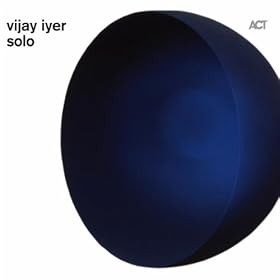
Review: Solo

Vijay Iyer


The solo album has long been an obligatory statement of artistic mastery for jazz pianists. Though there have been slight tweaks to the format (see for instance Bill Evans' Conversations With Myself or Charles Mingus' Mingus Plays Piano), it remains relatively unchanged: equal parts original tunes and standards that the pianist can stretch and mold into entirely new creations. I can't think of any major pianist over the age of 35 who has not released a solo album, it seems like one cannot be taken seriously as a jazz master without taking the plunge into unaccompanied expression. In his electronic press kit accompanying the album, Iyer called the project "the ultimate reveal," and "the most personal statement I could possible issue." I couldn't agree more. It is also a big risk. Not even Sonny Rollins can escape accusations of a subpar solo album (I know, bad analogy, since Sonny is a saxophonist and the solo album hasn't hurt his legacy). Upon multiple listens, though, I don't think Iyer has to worry about that.

In the past decade, one additional component has made its way into the solo piano album: the pop cover.* On Solo, Iyer chose to lead the album off with his version of Michael Jackson's Human Nature. I'm not much of a Micheal Jackson fan (which apparently is heresy for someone of my age, but whatevs), and Human Nature is not one of the MJ tunes I would ever throw on my iPod, but I do enjoy Iyer's rendition.


Iyer commences with a dazzling version of Thelonious Monk's Epistrophy, trading in Monk's easy swing for an intense, driving syncopation. The melody of Epistrophy, featuring Monk's trademark chromaticism, has a touch of drama, but Iyer accentuates the dramatic. His left hand is especially heavy, while the right moves at a breakneck pace. It is by far the most exhilarating version of the tune I have heard, and repeated listens have not made the excitement fade. The first third of the album concludes with two more standards, the DeLange/Van Heusen classic Darn That Dream and Duke Ellington's showpiece for Bubber Miley and Tricky Sam Nanton, Black and Tan Fantasy. Black and Tan, with its plungered trumpet and trombone duet, is an especially odd choice for solo piano. How can a rigid instrument match Miley's manipulation of the trumpet which approaches the sound of the human voice? Iyer opts to play the tune as Ellington might have played it, in a dirge-like stride style reminiscent of Ellington's hero, Willie "The Lion" Smith. The result allows the tune itself to take center stage. Iyer is content to allow the harmonies shine, and his adherence to the stride style in his version manage to open up a rich world of improvisation without making the tune sound quaint.

Iyer bookends the album with another Ellington composition, Fleurette Africaine, followed by One For Blount, a blues dedicated to Sun Ra. As with Black & Tan Fantasy, Iyer plays the melody of Fleurette Africaine relatively straight, content to marvel at the beauty of Ellington's harmony. Iyer accentuates the ironic darkness of the melody, giving added weight to the tune. It is an underrated piece of the Ellington canon, and I'm glad Iyer decided to record it.


As captivating as his versions of other people's tunes are on Solo, it is Iyer's originals, covering the middle third of the album, which really shine. As with much of his other work, these tunes are highly improvisational but push the boundaries of postbop (in some cases ignoring them completely). Prelude: Heartpiece is an exploration of consonance and dissonance, comprised of a simple three-note phrase over a pulsing bass line, alternately building and releasing tension. It is followed by Autoscopy, a frantic composition of startling energy that is half Cecil Taylor energy, half ostinato. Iyer shocks you to attention, then lulls you into a peaceful slumber which segues into Patterns, the highlight of the album in my mind. Iyer slowly constructs the main theme, sustaining individual notes of the melody for the first 90 seconds before stating the melody. The independence of the right hand from the left is astonishing, against a sequence of triplets in the treble clef, Iyer plays a syncopated staccato rhythm with his left hand that both disrupts and propels the melody. This accompaniment persists in some form or another throughout the tune, grounding Iyers flights across the keyboard and giving a thematic unity to the eight-minute piece which sounds more like a multimovement suite than a single tune. At times calmly melodic, at others reflecting Iyer's scientific background through the exploration of fractured motifs, it is a microcosm of the album, fulfilling Iyer's characterization of "the ultimate reveal."

Bonus Material: EPK


Personnel: Vijay Iyer, piano
Track Listing: Human Nature; Epistrophy; Darn That Dream; Black and Tan Fantasy; Prelude: Heartpiece; Autoscopy; Patterns; Desiring; Games; Fleurette Africaine; One For Blount

*This is not entirely new, since pianists playing Tin Pan Alley tunes in the postwar years were playing pop tunes. In this context, a pop tune refers to a non-Tin Pan Alley song written in the recent past (e.g. Jason Moran's version of Planet Rock).

11 September 2010

Weekend Reading

Fall is coming...

19 October 2009

Review: Historicity

Vijay Iyer Trio

One of the major undercurrents in the recent Jazz Now discussion was the thorniness inherent in addressing a Jazz Tradition. For those of us, like myself, who consider jazz to be an oral tradition, it follows that the best jazz can both reference (and even revere) the past while situating itself firmly in the present and offering a jumping off point for the future (hence the oft-cited Ralph Ellison quote, "One of the chief values of living with music lies in its power to give us an orientation in time").

But referencing the past while making a statement of the present is not so easily achieved, which makes Vijay Iyer's latest effort, Historicity, all the more impressive. Iyer and his long-standing trio featuring bassist Stephan Crump and drummer Marcus Gilmore tackle a number of tunes already familiar to listeners, as well as a couple of originals recorded on earlier Iyer albums. While the song selection is bold (including covers of the M.I.A., Ronnie Foster, and Leonard Bernstein), the execution makes the album seem less like a novelty and more like the work of artists who are genuinely interested in finding out whether great music retains its endearing qualities when recontextualized.

And the answer, in this case, is assuredly affirmative. The trio effectively creates little worlds in each track on the album, from the ethereal mist of the title track to the expansive voids of Somewhere to the jagged iciness of Dogon AD. On the latter and Mystic Brew as well, Iyer, Crump, and Gilmore show the limitless possibilities inherent in a single rhythmic motif. The music on the album reflects a trio with a very detail-oriented and well-conceived purpose of vision. Such planning often yields fruitful results.

Perhaps predictably, Iyer has run into some unnecessary criticism surrounding his intellectualized approach to jazz. One recent album reviewer, writing for All About Jazz, complained that the "miasma of cerebralization" surrounding Iyer's music is irritating, and that Iyer's liner notes,1 which quote the Italian philosopher Antonio Gramsci, "rings alarm bells." However, these complaints, which were limited to Iyer's liner notes, and not his music, ring hollow upon listening to the album. Iyer is an incredibly thoughtful musician who pours a lot of intellectual energy into his music (his recent interview on The Jazz Session is a great example, as is this article he wrote for the Guardian about Fibonacci numbers and his rendition of Ronnie Foster's Mystic Brew). However, his music retains a deeply intuitive sense of rhythm which prevents things from getting too sterile. Indeed, if you listened to the entire album before reading the liner notes, the "miasma of cerebralization" critique would likely make little sense.


Video Content: The Vijay Iyer Trio play's M.I.A.'s Galang:


BONUS MATERIAL: Vijay pops in at Destination: OUT to post two live recordings of his trio from February. Many thanks to Vijay and the Jeffs for making that happen.


Track Listing: Historicity; Somewhere; Galang; Helix; Smoke Stack; Big Brother; Dogon A.D.; Mystic Brew; Trident: 2010; Segment for Sentiment #2
Personnel: Vijay Iyer, piano; Stephan Crump, bass; Marcus Gilmore, drums


1Iyer posted the full text of his liner notes in the comment section of this review.

09 October 2009

A Minor Corrective to the Jazz In Crisis Meme


Jazz fans are passionate to a fault, and us jazz bloggers even more so. In the wake of Terry Teachout's Wall Street Journal piece on the decline of the jazz audience, a whole host of bloggers have picked the piece apart, started a campaign to promote live jazz, and offered suggested albums to recommend to non-jazz listeners, among other responses. While the responses were thoughtful, they also (inadvertently) reveal a sense of defensive panic, as if we bloggers need to prove the vitality of jazz in the 21st century.

But I wish to offer a slightly more optimistic take on the situation. Instead of talking about the audience, I'll follow Patrick Jarenwattananon's lead and instead focus on the music. What is lost in the uproar over the audience is the fact that we are currently living in a golden age of piano trios. Not only are there a bunch of exciting groups putting out fantastic music, but the pantheon of these trios all have such an individual sound that even jazz neophytes can tell them apart. Below are just a few of the trios that are making the present moment such a satisfying one for jazz listeners.

Brad Mehldau Trio: Mehldau has loomed large over the jazz scene for over a decade, and his trio with bassist Larry Grenadier and drummer Jeff Ballard have put out a number of great albums over the last decade. I consider them the standard bearer of this group.


The Bad Plus
: Though we may be tempted to dub them enfants terribles for their deconstructive covers of pop and rock tunes, The Bad Plus are more of a postmodern edition of the traditional jazz piano trio.


Vijay Iyer Trio
: I'll let the rest of the jazz blogosphere do the talking here. I'll be giving their newest album, Historicity, a full review soon, but suffice it to say that it might be the best album of 2009. Iyer, bassist Stephan Crump, and drummer Marcus Gilmore have a fantastic musical rapport.


Keith Jarrett Standards Trio: The reigning master of repertory, along with bassist Gary Peacock and drummer Jack DeJohnette, will consistently knock your socks off with their discursive explorations of standards.


Robert Glasper Trio: Glasper gets a bit more pub for his Experiment band, but the acoustic trio is also a pretty good show.


Jason Moran's Bandwagon: Moran packs the entire history of jazz piano in his playing, but keeps it fresh and exciting. Bassist Tauras Mateen and drummer Nasheet Waits match him blow for blow in energy.


Medeski Martin & Wood
: Probably the most sui generis of this list, which is saying something. John Medeski usually sticks to electric instruments, but he is underrated on the acoustic piano.


Did I forget someone? Let me know in the comments...


Image via EyeShotJazz.

Stats