Showing posts with label Esperanza Spalding. Show all posts

21 February 2011

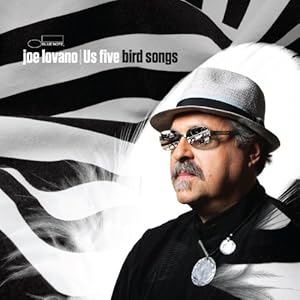
Review: Bird Songs

Joe Lovano Us Five
Bird Songs


NPR recently ran a list of the 100 quintessential jazz songs, as determined by a popular poll. As you might expect, most of the songs on the list were over 40 years old. The top-ranked song recorded after 1970 (at number 8) was Birdland, by Weather Report. Nothing on the list was recorded after 1980. I found this especially annoying, since polls like this only reinforce the biases of some that jazz is dead.

Yet while a poll venerating old material annoyed me, I greatly anticipated an album doing just the same thing, Joe Lovano Us Five's Bird Songs. A tribute to the music of Charlie Parker, Joe Lovano has spearheaded a self-conscious look backward that remains fixed in the present. Lovano's quintet, in its second offering for Blue Note, reworks and performs a number of Charlie Parker tunes without reflecting a slavish devotion to the past.

This is not Lovano's first foray into the repertoir of the bebop era. His 2000 nonet album 52nd Street Themes included a heavy dose of Tadd Dameron. But while that album featured a number of sidemen in varying groups, Bird Songs is performed by a group that is very comfortable with itself, and this comfort allows for more risk-taking and spontaneity. Pianist James Weidman is a seasoned pro who knows how to best accompany Lovano, leaving him plenty of space while providing a light counterbalance to Lovano's gruff tone. fluidly works together

Plenty has been said about bassist Esperanza Spalding's solo work in light of her surprise Grammy win last week, but this album finds her in a different setting than her own albums. Even without the spotlight, her contributions are crucial. With two drummers constantly shifting between background and foreground, Spalding is a strong rhythmic anchor. And when she solos, as on Yardbird Suite, she shows the incredible chops that made even Grammy voters take notice, dexterously working all over the neck of her bass.

A number of tunes have a Caribbean feel, with drummers Otis Brown III and Francisco Mela making ample use of the multifaceted tambres, inflections, and feels afforded by featuring two drummers. Barbados, Birdyard and Dewey Square all capture a calypso influence which occasionally popped up in Bird's work. But here it is played up, to my delight. A Parker tribute with only bebop rhythm would both sell his own music short and provide an unnecessary restriction to the possibilities inherent in his tunes.

Lovano dares to take Parker's tunes in unexpected directions, though, like when he takes the Miles Davis tune Donna Lee, originally a barnburner, at a strolling pace behind the freeish drumming of Brown and Mela. On Birdyard, a variation on Yardbird Suite, Lovano switches to Aulochrome, a polyphonic saxophone (the first of its kind), alternating between unison, dissonance, and consonance in a way that suggests the competing songs of birds. On Ko Ko, a trio with his drummers, Lovano shows how easily he can carry a tune on his own with his forceful sound and fiercely individual personality. As with the rest of this album, the performance fittingly reflects an artist who knows himself well enough to take the listener on personal explorations of sound, with a group who also knows the way to go.

---


Track Listing:  Passport; Donna Lee; Barbados; Moose the Mooche; Lover Man; Birdyard; Ko Ko; Blues Collage; Dexterity; Dewey Square; Yardbird Suite
Personnel: Joe Lovano, saxophones; James Weidman, piano; Esperanza Spaulding, bass; Francisco Mela, Otis Brown III, drums

On Exclusivity

When Esperanza Spalding was awarded the Best New Artist Grammy last week, surely somewhere some Esperanza fan was secretly lamenting the fact that the entire world now knows who she is. If jazz fans share a [defect], it is a sometimes regretful fetishizing of the little-known. For some of us, a (very) small part of the joy that comes from listening to jazz is the knowledge that we are hip to some artistic stuff most people have missed. And when the rest of the world catches up to you, it can be disappointing. "I knew about Esperanza before she won a Grammy" showed up once on my Facebook newsfeed this week, and I'm sure I'm not alone in the regard.

We can't help it. Jazz is in a cultural place partly of its own creation, outside the mainstream (for the most part) except as a curious historical artifact or marker of artistic respectability, depending on the situation. It takes devotion to seek out and learn about jazz. You can't "get it" all at once, you must work at listening to the music to fully appreciate its majesty. That's what we tell anyone who claims not to understand jazz, at least.

Case in point, I like to tell people that my younger brother was hip to Herbie Hancock before I was. He is two years younger than me, and in eighth grade or so he started picking up Herbie's Blue Note work, and went into some varsity level Herbie before I even comprehended what Herbie was doing. He was especially fond Empyrean Isles, the 1964 album that introduced Cantaloupe Island. But that now-standard aside, the disc is a knotty piece of postbop, whose advanced harmonies, polyrhythms, and melodicism are not readily apparent to most listeners, much less the sixteen-year-old version of myself. But Ted had it around, along with Takin' Off, Maiden Voyage, and Head Hunters (the only non-Blue Note in his collection at the time, to the best of my knowledge).


But within a year, I had heard Herbie enough to start to absorb what he was doing, and now Empyrean Isles is among my favorite albums of the 1960s. And I feel better about liking it having had to work at it. The fact that I only slowly warmed up to it means little intrinsically, but it deepens my affinity for the album, knowing that others may not have the stamina to work their way up to an album like this.

And there can be nothing worse (or more inconsequential) than learning one of your perceived little-shared favorites becomes popular all of a sudden. But here's the deal: Don't complain about it on Facebook. Seriously, you look like an asshole when you do that, please give it a rest. Thanks!

14 February 2011

What They're Saying About Esperanza Spaulding


Peter Hum:
Cyber-vandalism aside, it has to be a good thing that with Spalding's victory, more people outside the jazz bubble are receiving one more gentle poke in the ribs that jazz is out there and that it matters.
Patrick Jarenwattananon:
There's a theme here. Among many of her fans, the biggest takeaway of her win was that "real," comprehensive musicianship was being rewarded over commercial success (at least among the choices given). Indeed, plenty of the underpinnings of Spalding's music — risk-taking, improvisation, instrumental mastery — are severely underserved in the pop mainstream.
Nate Chinen:
With hindsight, the calculus behind her win seems deceptively clear, though the Recording Academy doesn’t divulge vote tallies. Drake and Mr. Bieber — both Canadians, both accessing a current of R&B — may have split one segment of the voting body. The other two nominees, Florence & the Machine and Mumford & Sons — both English, both slightly throwback in their appeal — may have split another. More important, though, was the marvel of Ms. Spalding’s effervescent prowess as a musician and a singer. Virtuosity has always played well with Grammy voters, and so has the comforting vision of a bright young artist upholding established ideals of quality.
Howard Mandel:
It's hard not to gloat about talent winning out. Of course, Bieber is crying all the way to the bank. On the other hand, Spalding may have a longer and more interesting career. Here's hoping...
Andrew Durkin:
I don't know Spalding's music very well, and I don't know Bieber's music at all. (Lucky for me, my six year old doesn't know Bieber's music either.) Plus, it's silly to pretend that the Grammys are a true barometer of musical value. But even from a distance, this was a pleasant turn of events, and it should make us all smile a little bit.
I agree wholeheartedly

Congratulations Esperanza

Via Peter Hum, Justin Bieber trolls are both racist and uncreative:


Congrats to Esperanza on her Best New Artist Grammy. The Bieber fans are probably just jealous that she never needed a swagga coach...

23 January 2011

An Oral Tradition

A blog post from James Hale this week had me reconsidering a question which I had wanted to ponder in a blog post awhile back, but eventually decided it wouldn't be worth the effort. At Jazz Chronicles, Hale asks, "Is 'Jazz' A Dated Term?" The impetus for this question was an ostensibly heated debate at a Jazz Journalists Association conference panel entitled "The State of Jazz Journalism" (any panel titled The State of _______ foreshadows contentious debate that may not be worth it, in my opinion). Alex Rodriguez responded to the post and posted his thoughts on the subject as well. Rodriguez contends that jazz journalists and critics share a responsibility to help the jazz audience (which is "sort of like a big, dysfunctional family") achieve balance in its understanding of the music, navigating between the poles of an ahistorical and "only-historical" approach to understanding jazz. I'm left with the intention to simply ignore both poles in favor of a different analytical framework altogether.

My only reservation about writing a jazz blog is that jazz writing is surrounded by this aura of responsibility. Jazz writers and critics are assigned (or assign themselves) a gatekeeper role which is unmatched in most areas of music journalism. Classical critics are superseded in this role by repertory, rock and hip hop critics by a more easily-arrived-at definition of the musics they cover (I'm overgeneralizing here, but bear with me). I follow a lot of indie rock blogs, and I can't recall any of them ever contending with the existential dilemmas that jazz bloggers address every few months or so. To mention just one example, nobody batted an eye when Gorilla vs. Bear included albums by Beach House, Big Boi, Arcade Fire, and Erykah Badu on its 2010 albums of the year list, even though those four artists occupy vastly different corners of the music world. I can't think of any jazz blog that included nonjazz on its year-end list (even my own list was divided into jazz and nonjazz). What strikes me about this is that probably not many people would mind if someone did this, but jazz bloggers effectively policed themselves, driven by the self-imposed responsibility to promote jazz ahead of other types of music (ostensibly because jazz is always dying, or at best, holding steady). The irony here, of course, is that the jazz world is such a complex ecosystem, a place where Wynton Marsalis, the Robert Glasper Experiment, and any number of swing, traditional jazz/Dixieland, postbop, neobop, acid jazz, and jazz-rock artists can coexist on a single record-store shelf. Adding a layer of segregation to year-end lists seems arbitrary to a silly degree.

But I digress. On the question of jazz being an outdated term or an inadequate genre signifier, I must confess that the word has a continually decreasing utility to me except as a quick and dirty signifier when people ask me what kind of music I like. When I reply "jazz," the conversation never goes in the same direction, because the fact is, stories of the death of jazz to the contrary, most people know what jazz is, and a surprising number of them have at least some jazz artist they can count among their favorite musicians, be it a singer like Nina Simone or Billie Holiday, a deceased legend like Miles Davis or Charlie Parker, or a current act like Medeski Martin and Wood or Esperanza Spaulding. This is because jazz remains an oral history with many branches, one with the "only-historical" approach to understanding the music already incorporated into individual artists' personalities and musical background. It may not be immediately obvious to everyone who hears the music (indeed, you can't really hear jazz until you've listened to a lot of it first).

Indeed, Rodriguez makes this point when he champions Jason Moran, whose music "starts from a historical place." Moran is not the only artist whose music is historicized. In a recent interview, Vijay Iyer (who titled a recent album Historicity, in case you were wondering how he grounded his approach) said of jazz:
I don't think of it as a style even. I think of it as a community of people who are invested in it. And I also think of it as a body of knowledge. You can say it's a history of ideas, and also, a history of actions. I think part of what's happened is that its reason for existing has transformed in terms of who's involved and why.
I am tempted to block-quote his entire answer, but he goes into a lot of detail, so I'll paraphrase here. Iyer notes that because the socio-economic circumstances upon which jazz was built have changed (i.e. jazz musicians for the most part no longer come from an oppressed minority whose avenues for artistic self expression were limited by society), jazz itself has changed, and has grown and diversified to the point that the word cannot contain the music anymore. But even still, jazz musicians are still striving towards an expression of the self that feels "in its own small way impossible." For Iyer, this is connected to his own status as a man born from first-generation Indian immigrants, creating a new identity of the South Asian-American jazz musician. For someone else, there is another identity to invent. Because jazz is a music of invention, as time moves on the inventions multiply into a fractal of multitudes which may not all sound alike, but nonetheless remain jazz. They are born into the same tradition, but take it places that make sense to them.

I am reminded of what Esperanza Spalding told Anthony Dean-Harris in an interview last year:

We need all the aspects of it [jazz] and that’s okay. We need the Wynton Marsalis and we need the Anthony Braxton and we need a Chris Botti and we need Christian Scott. We need a Ledisi and we need a Rachelle Ferrell. We need everything... We need it all because that word doesn’t belong to anybody anymore. It’s become so broad that to me the only element of that word that has any meaning universally is just improvisation. Jazz can be anything but maybe the only element that's there across the board is that people are creating it in the moment.
Improvisation, too, but that is merely the tool for the self-examination and expression which unite the myriad sub-genres which constitute jazz in the 21st century. I'm going to take a break from the big-picture questions for awhile, but when the other debate making the rounds is whether or not Keith Jarrett is an asshole (and he is), I'll choose the big-picture topic anytime.

photo via

02 December 2010

Grammy Awards

Grammy Award nominations came out this week, and while I usually wouldn't bother, it is worth noting that Esperanza Spaulding was nominated for Best New Artist. While I doubt she'll win (the award will probably go to Justin Bieber or Drake, unfortunately), at least The Recording Academy is taking jazz seriously, and not fully ghettoizing the music in its own category. Chalk up a point for the "Jazz is not dead, it just smells funny" camp. You can view the jazz nominations here.

07 May 2010

Must Reads

Did you hear? The jazz wars are back on. Well, sort of. This week saw two takes on the ongoing debate over what is and isn't jazz from Peter Hum and Nextbop's Anthony Dean-Harris. You should read them, for I don't want to spoil their arguments by excerpting them here.

I suppose I should weigh in, and I may work out my thoughts for a long-form piece later this month. In the meantime, suffice it to say that I'm with Esperanza, with the added rejoinder I posted on Jason Parker's blog a few months ago on the declining utility of jazz as a brandname. More on that later, though.

Stats