
Showing posts with label Joe Lovano. Show all posts
Showing posts with label Joe Lovano. Show all posts
11 November 2014
Sound Prints
Dave Douglas and Joe Lovano's quintet with Lawrence Fields, Linda Oh, and Joey Baron. So killing:

21 February 2011
Review: Bird Songs
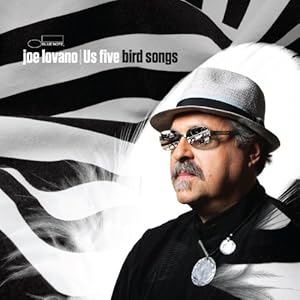
Joe Lovano Us Five
Bird Songs
Bird Songs

NPR recently ran a list of the 100 quintessential jazz songs, as determined by a popular poll. As you might expect, most of the songs on the list were over 40 years old. The top-ranked song recorded after 1970 (at number 8) was Birdland, by Weather Report. Nothing on the list was recorded after 1980. I found this especially annoying, since polls like this only reinforce the biases of some that jazz is dead.
Yet while a poll venerating old material annoyed me, I greatly anticipated an album doing just the same thing, Joe Lovano Us Five's Bird Songs. A tribute to the music of Charlie Parker, Joe Lovano has spearheaded a self-conscious look backward that remains fixed in the present. Lovano's quintet, in its second offering for Blue Note, reworks and performs a number of Charlie Parker tunes without reflecting a slavish devotion to the past.
This is not Lovano's first foray into the repertoir of the bebop era. His 2000 nonet album 52nd Street Themes included a heavy dose of Tadd Dameron. But while that album featured a number of sidemen in varying groups, Bird Songs is performed by a group that is very comfortable with itself, and this comfort allows for more risk-taking and spontaneity. Pianist James Weidman is a seasoned pro who knows how to best accompany Lovano, leaving him plenty of space while providing a light counterbalance to Lovano's gruff tone. fluidly works together
Plenty has been said about bassist Esperanza Spalding's solo work in light of her surprise Grammy win last week, but this album finds her in a different setting than her own albums. Even without the spotlight, her contributions are crucial. With two drummers constantly shifting between background and foreground, Spalding is a strong rhythmic anchor. And when she solos, as on Yardbird Suite, she shows the incredible chops that made even Grammy voters take notice, dexterously working all over the neck of her bass.
A number of tunes have a Caribbean feel, with drummers Otis Brown III and Francisco Mela making ample use of the multifaceted tambres, inflections, and feels afforded by featuring two drummers. Barbados, Birdyard and Dewey Square all capture a calypso influence which occasionally popped up in Bird's work. But here it is played up, to my delight. A Parker tribute with only bebop rhythm would both sell his own music short and provide an unnecessary restriction to the possibilities inherent in his tunes.
Lovano dares to take Parker's tunes in unexpected directions, though, like when he takes the Miles Davis tune Donna Lee, originally a barnburner, at a strolling pace behind the freeish drumming of Brown and Mela. On Birdyard, a variation on Yardbird Suite, Lovano switches to Aulochrome, a polyphonic saxophone (the first of its kind), alternating between unison, dissonance, and consonance in a way that suggests the competing songs of birds. On Ko Ko, a trio with his drummers, Lovano shows how easily he can carry a tune on his own with his forceful sound and fiercely individual personality. As with the rest of this album, the performance fittingly reflects an artist who knows himself well enough to take the listener on personal explorations of sound, with a group who also knows the way to go.
---
Track Listing: Passport; Donna Lee; Barbados; Moose the Mooche; Lover Man; Birdyard; Ko Ko; Blues Collage; Dexterity; Dewey Square; Yardbird Suite
Personnel: Joe Lovano, saxophones; James Weidman, piano; Esperanza Spaulding, bass; Francisco Mela, Otis Brown III, drums
29 January 2011
List: Jazz and the Single Man
Floating around social networks this week was an essay by Jason Moran listing five essential jazz albums (recorded by living musicians - so you could actually see them live) every man should own. Why should he own these albums? To impress women,* of course. Here is Moran's list. I think it's a good start, but it veers into jazz boyfriend territory (Ornette? Free Jazz? I don't know many people of either sex who can handle Ornette, bless their simple hearts and minds). So in the interest of choice, here's my list of 5 jazz albums every single man should own.
Robert Glasper, Double Booked. Moran and I agree on this one. Glasper's deftly amalgamated jazz, with flourishes of hip hop, fusion, funk, and postbop, can hook anyone who claims ignorance on modern jazz. I've been touting this album to my friends for the past two years, and it connects with just about everyone. Plus, Glasper tours with Maxwell, a spoonful of sugar to hide preconceived notions about jazz if ever there was one.
Greg Osby, Jason Moran, et al, New Directions. Sadly out of print, but there are copies to be had on Amazon. Not a bad choice to play for someone who is at least a little familiar with jazz, since they would likely recognize a few of the reworked classics from the Blue Note era on this disc. I highly recommend the Moran-Stefon Harris duet on Sam Rivers' Beatrice.
Sonny Rollins, Saxophone Colossus. Moran picks a great Wayne Shorter album, but I was always more of a Sonny guy myself, and if a lady can't dig Newk, then she is most definitely not worth your time.
Paul Motian, Joe Lovano and Bill Frisell, Time And Time Again. For quiet moments, you can't beat the master of subtle intensity. Frisell's atmospheric guitarisms set the mood for Lovano's gruff tenderness. This trio to me embodies a particular strain of masculinity that is equal parts vulnerable and assertive.And no other group better demonstrates the sublime intensity of free improvisation, despite playing such pretty music.
Medeski Scofield Martin & Wood, Out Louder. Sometimes you have to dance. This should do the trick.
Robert Glasper, Double Booked. Moran and I agree on this one. Glasper's deftly amalgamated jazz, with flourishes of hip hop, fusion, funk, and postbop, can hook anyone who claims ignorance on modern jazz. I've been touting this album to my friends for the past two years, and it connects with just about everyone. Plus, Glasper tours with Maxwell, a spoonful of sugar to hide preconceived notions about jazz if ever there was one.
Greg Osby, Jason Moran, et al, New Directions. Sadly out of print, but there are copies to be had on Amazon. Not a bad choice to play for someone who is at least a little familiar with jazz, since they would likely recognize a few of the reworked classics from the Blue Note era on this disc. I highly recommend the Moran-Stefon Harris duet on Sam Rivers' Beatrice.
Sonny Rollins, Saxophone Colossus. Moran picks a great Wayne Shorter album, but I was always more of a Sonny guy myself, and if a lady can't dig Newk, then she is most definitely not worth your time.
Paul Motian, Joe Lovano and Bill Frisell, Time And Time Again. For quiet moments, you can't beat the master of subtle intensity. Frisell's atmospheric guitarisms set the mood for Lovano's gruff tenderness. This trio to me embodies a particular strain of masculinity that is equal parts vulnerable and assertive.And no other group better demonstrates the sublime intensity of free improvisation, despite playing such pretty music.
Medeski Scofield Martin & Wood, Out Louder. Sometimes you have to dance. This should do the trick.
*Would a list of jazz albums for women to impress men look a lot different? What about jazz for gay men or lesbians? Obviously the answer is yes, but I'm pleading ignorance here.
02 July 2009
Review: Folk Art

 On his newest album, Joe Lovano exhibits the adventurousness you would expect from someone who plays regularly with Paul Motian. Pianist James Weidman also stars here, soloing provocatively and banging out chords while comping in a manner evocative of McCoy Tyner. And bassist Esperanza Spaulding lays down an impressive foundation ornamented by dual drummers Francisco Mela and Otis Brown III. If he keeps this band together, it could quickly become one of the best working groups in jazz. Take a listen to the interplay on "Us Five."
Extra Credit: Jazz Video Guy Bret Primack gets a behind-the-scenes look at Lovano's quintet before a performance at the Village Vanguard.
Track Listing: Powerhouse; Folk Art; Wild Beauty; Us Five; Song for Judi; Drum Song; Dibango; Page 4; Ettenro
Personnel: Joe Lovano, saxophone; James Weidman, piano; Esperanza Spaulding, bass; Francisco Mela, Otis Brown III, drums
07 June 2009
Under The Radar: Sounds of Joy
Joe Lovano

 Having recently reviewed new releases from Joshua Redman and Fly, I have been thinking a lot about the saxophone-bass-drums trio. Though I usually enjoy these albums, I am often left feeling there is a certain underlying sameness present on these albums: Sonny Rollins plus John Coltrane with bits of Ornette Coleman added for flavor. This is not to say that these saxophonists all sound the same, but that they are often drawing from the same well. However, there is one saxophone trio album that has been on my mind lately, chiefly because it does not sound like any of the other saxophone trio albums that have passed through my iPod lately.
A major reason this album sticks out from most other saxophone trios is Lovano's sound on tenor. Though he is steeped in the same rhythmic and harmonic traditions as Redman, Mark Turner, Chris Potter, and any number of other tenormen, his tone is a throwback to the gruff sounds of Ben Webster or Coleman Hawkins. Whereas most current tenor saxophonists sound much like John Coltrane or Joe Henderson, with a clean, even tone, Lovano almost sounds as if it is a struggle to make a tone on his horn. It is a refreshing deviation from the norm, and one of the traits that first drew me to Lovano's work.
For an example of Lovano's sound, see this YouTube of Lovano playing in a trio setting:
Lovano's signature sound is on full display on Sounds of Joy, but the album is of course also notable for his improvisations and the alchemy cultivated between Lovano, bassist Anthony Cox, and drummer Ed Blackwell. For a group that ostensibly did not play much together live (though I could be wrong), these three played very well together (which is not a surprise in the case of Blackwell - if he could keep up with Ornette Coleman, then he could hang with anyone else). Apropos of Coleman, the tunes on the album (including four Lovano originals) are quite reminiscent of Ornette in that they feature simple but catchy melodies that stand out on their own.
But I digress. One of the lingering criticisms of contemporary jazz is that with so many players developing within an institutionalized jazz education structure (under which instrumentalists study mostly the same stylistic forebears at the conservatory/university), most (if not all) of the up-and-coming jazz musicians sound an awful lot alike, save for some nuances. Someone as distinctive as Thelonious Monk could never make it out of the conservatory without losing what makes him unique, according to this line of criticism. Listening to someone like Lovano, whose sound reflects an era of jazz which sometimes receives short shrift from modern players, is a refreshing foray into an alternate universe of jazz, where instrumentalists can develop out of a much more diverse pool of influences.
EXTRA CREDIT: Those looking for more Lovano would do well to check out Grand Slam, a live recording featuring Lovano with Jim Hall, George Mraz, and Lewis Nash. If you can handle that, follow it up with any of Lovano's albums with Paul Motian and Bill Frisell (including I Have the Room Above Her, Time and Time Again, and Sound of Love).


Track Listing: Sounds of Joy; Strength and Courage; I'll Wait and Pray; Cedar Avenue and Space; Bass and Space; Ettenro; Until the Moment Was Now; This One's For Lacy; 23rd Street Theme
Personnel: Joe Lovano, saxophone; Anthony Cox, bass; Ed Blackwell, drums
Subscribe to:
Posts (Atom)

