Showing posts with label Under the Radar. Show all posts

26 July 2010

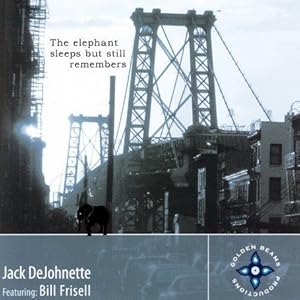
Under the Radar: The Elephant Sleeps But Still Remembers


Jack DeJohnette featuring Bill Frisell
The Elephant Sleeps But Still Remembers


When some albums go out of print, I mourn for those who will miss their chance at hearing them. Such is The Elephant Sleeps But Still Remembers, an exploratory gem from Jack DeJohnette and Bill Frisell. Fulfilling his reputation as an adventurous spirit, DeJohnette masterminds an effort worthy of its own entry at destination: OUT. The album was recorded at the 2001 Earshot Festival in Seattle, with bass lines, effects, ambient sounds, and loops added by DeJohnette and sound engineer Ben Surman in post-production.

The tunes on The Elephant Sleeps But Still Remembers fall into two categories: grooves and explorations. The title track falls in the former. Leading off the album, Bill Frisell lays down a spooky extended blues over DeJohnette's heavy rhythms. The effects in the background give the tune a darker, more animated mood which really enhances the tune. Frisell and DeJohnette play so well off each other, with one seamlessly filling the gaps left over by the other. The song is followed by Cat and Mouse, a tune in the latter category on which DeJohnette plays various percussion and finger keyboards while Frisell picks some free banjo. It is very outside, I think Frisell plays banjo here the way Don Cherry plays trumpet. It is nonsensical in a way but also very fun to hear. Frisell's playfulness shines through.

Another such sound exploration comes on Cartune Riots. I really can't tell who is doing what on this track, but it sounds like an alternate universe in a Marvin the Martian tune which may or may not give you nightmares and maybe flashbacks. It will turn off many listeners, to be sure, but I appreciate the effort.

One of Frisell's strengths is his sense of melody, which allows him to craft solos full of little ideas from the same harmonic palette. This is evident in Ode to South Africa, the highlight of the disc. Frisell plays about six minutes in F major, but he doesn't repeat himself and doesn't dwell on one motif for more than sixteen measures or so. Under him, DeJohnette demonstrates that the drumset was originally a recreation of an African drum ensemble. He moves from an exploration of the toms into a robust 4-4 groove on ride cymbal and open snare. Frisell's solo builds up to a feeling of euphoria which accompanies a loop of African voices that echo through the final ninety seconds of the tune. Of all the Frisell solo's I've heard, I think this one is my favorite.

The album closes with John Coltrane's After the Rain, and DeJohnette and Frisell accomplish the feat of reworking a Coltrane tune so well that I prefer it to the original (which rarely happens). Switching to piano, DeJohnette augments the melody with some whimsical lines on piano to give the tune a dream-like haze. Combined with Frisell's spare comping, it's the perfect cool-down. Like a post-coital nap, it is a calming restoration of the senses which leaves the listener completely at peace. Serenity now.


Track listing: The Elephant Sleeps But Still Remembers...; Cat and Mouse; Entranced Androids; The Garden of Chew-Man-Chew; Otherworldly Dervishes; Through the Warphole; Storm Clouds and Mist; Cartune Riots; Ode to South Africa; One Tooth Shuffle; After the Rain
Personnel: Jack DeJohnette: drums, percussion, vocals, piano; Bill Frisell: guitar, banjo; Ben Surman: additional percussion

07 June 2009

Under The Radar: Sounds of Joy

Joe Lovano

Having recently reviewed new releases from Joshua Redman and Fly, I have been thinking a lot about the saxophone-bass-drums trio. Though I usually enjoy these albums, I am often left feeling there is a certain underlying sameness present on these albums: Sonny Rollins plus John Coltrane with bits of Ornette Coleman added for flavor. This is not to say that these saxophonists all sound the same, but that they are often drawing from the same well. However, there is one saxophone trio album that has been on my mind lately, chiefly because it does not sound like any of the other saxophone trio albums that have passed through my iPod lately.

A major reason this album sticks out from most other saxophone trios is Lovano's sound on tenor. Though he is steeped in the same rhythmic and harmonic traditions as Redman, Mark Turner, Chris Potter, and any number of other tenormen, his tone is a throwback to the gruff sounds of
Ben Webster or Coleman Hawkins. Whereas most current tenor saxophonists sound much like John Coltrane or Joe Henderson, with a clean, even tone, Lovano almost sounds as if it is a struggle to make a tone on his horn. It is a refreshing deviation from the norm, and one of the traits that first drew me to Lovano's work.

For an example of Lovano's sound, see this YouTube of Lovano playing in a trio setting:


Lovano's signature sound is on full display on Sounds of Joy, but the album is of course also notable for his improvisations and the alchemy cultivated between Lovano, bassist Anthony Cox, and drummer Ed Blackwell. For a group that ostensibly did not play much together live (though I could be wrong), these three played very well together (which is not a surprise in the case of Blackwell - if he could keep up with Ornette Coleman, then he could hang with anyone else). Apropos of Coleman, the tunes on the album (including four Lovano originals) are quite reminiscent of Ornette in that they feature simple but catchy melodies that stand out on their own.

But I digress. One of the lingering criticisms of contemporary jazz is that with so many players developing within an institutionalized jazz education structure (under which instrumentalists study mostly the same stylistic forebears at the conservatory/university), most (if not all) of the up-and-coming jazz musicians sound an awful lot alike, save for some nuances. Someone as distinctive as Thelonious Monk could never make it out of the conservatory without losing what makes him unique, according to this line of criticism. Listening to someone like Lovano, whose sound reflects an era of jazz which sometimes receives short shrift from modern players, is a refreshing foray into an alternate universe of jazz, where instrumentalists can develop out of a much more diverse pool of influences.


EXTRA CREDIT: Those looking for more Lovano would do well to check out Grand Slam, a live recording featuring Lovano with Jim Hall, George Mraz, and Lewis Nash. If you can handle that, follow it up with any of Lovano's albums with Paul Motian and Bill Frisell (including I Have the Room Above Her, Time and Time Again, and Sound of Love).

Track Listing: Sounds of Joy; Strength and Courage; I'll Wait and Pray; Cedar Avenue and S
pace; Bass and Space; Ettenro; Until the Moment Was Now; This One's For Lacy; 23rd Street Theme
Personnel: Joe Lovano, saxophone; Anthony Cox, bass; Ed Blackwell, drums

09 March 2009

Under The Radar: Tonic

Medeski Martin & Wood
Tonic

I've written about Medeski Martin & Wood's inimitable electronic acid jazz (I prefer to call it avant funk) before, but my favorite recording of theirs is actually Tonic, a live recording released in 2000. It is the only album which features the trio in an all-acoustic setting. While this makes it an outlier of the trio's catalogue, it is also a perfect example of their postmodernist approach to jazz. The trio weaves together four originals with four covers seamlessly into a solid hour of exciting jazz. The trio rework their covers into their shared language: groove-heavy, blues-drenched jazz with avant-garde color. Each tune stands on its own while fitting into the groove of the setlist. The album comes very close to replicating the excitement and spontaneity of a Medeski Martin & Wood set.

The trio begin with Invocation, a group improvisation which evokes the fire of Cecil Taylor. Medeski Martin & Wood often open their shows with a freewheeling opener. Most of the time, each member of the trio begins playing the second he gets to his gear, without waiting for the rest of the trio. This allows them to hit the ground running and feed off of the energy in the room. Invocation floats into one of my favorite tunes, Lee Morgan's Afrique. This is a particularly brave selection, being that it was first recorded by Art Blakey. It is one thing to cover a straight-ahead Blakey tune (think Moanin' or Along Came Betty), but to cover a tune that utilizes so much polyrhythm takes more than a little bit of guts. Drummer Billy Martin utilizes the cowbell wonderfully during the tune, and goes into a nice swing on the bridge. I think Art would have dug it.

Along with Afrique, a highlight of the set is the trio's performance of John Coltrane's Your Lady. The trio reimagine's the tune within a tight groove. Medeski and Wood play off of each other masterfully, adding depth and complexity to the groove without drowning it. As with most other Medeski Martin and Wood albums, Tonic serves as a series of case studies on grooves; from the dissonant energy of Seven Deadlies to the dark funk of Rise Up. Whereas lesser bands run the danger of simply employing groove for its own sake, Medeski Martin & Wood use the groove as a backdrop for deeper melodic exploration, a la John Coltrane's classic quartet.


The set closes with a version of the garage-rock classic, Hey Joe, that may strike some as anticlimactic (especially since it follows the frenetic Thaw). But I find it to be a nice bookend to the set, giving listeners a relaxing cool-down after the trio's workout. Tonic may not be the best introduction to Medeski Martin & Wood, but it is certainly a treasure among their catalogue which grows more rewarding with each listen.

Track Listing: Invocation; Afrique; Seven Deadlies; Your Lady; Rise Up; Buster Rides Again; Thaw; Hey Joe
Personell: John Medeski, piano; Chris Wood, bass; Billy Martin, drums, percussion

06 December 2008

Under the Radar: Percussion Bitter Sweet

Max Roach
Percussion Bitter Sweet

In the standard history-of-jazz retelling, Max Roach disappears in 1957. He shows up in the 1940s, when he was present at the creation of bebop, and, along with Kenny Clarke and Art Blakey, reinvented jazz drumming for a new generation. He shows up again in the mid-1950s, when he is leading a hard-bop quintet with Sonny Rollins and Clifford Brown that helps define the genre. Beyond that, he fades against the luminaries of Ornette Coleman, Miles Davis, John Coltrane, and others. Max Roach seemingly ceases to be a titan of jazz, slipping into historical obscurity.

In reality, while operating under the massive shadows cast by Ornette Coleman, John Coltrane, Miles Davis, and others during the 1960s, Max Roach produced some wonderful jazz in the early part of the decade worth revisiting. Though he would later recede from the jazz community,* his work early in the decade displayed an artist whose social activism reinvigorated his art following the tragic death of Clifford Brown in 1956. Roach thrust himself into the burgeoning civil rights movement during the late 1950s, raising money for various civil rights organizations, taking part in protests and sit-ins, and using his position as a professional musician to promote the cause in the media. His activism first seeped into his music with 1958's Deeds, Not Words, though one could argue that his founding of Debut Records with Charles Mingus in the early-1950s was also part of his activist streak, considering the socioeconomic environment in which musicians operated.

Roach's activism flourished as the 1960s began. In 1960, Roach helped organize a rebel counter-festival at the Newport Jazz Festival, hoping to promote younger up-and-coming musicians while protesting the low pay of the (usually black) artists who could not garner top billing. Later that year, Roach recorded We Insist! Max Roach's Freedom Now Suite, a multi-part work which chronicled the history of African Americans from slavery to 1960. The next year, Roach would record Percussion Bitter Sweet, with a veritable all-star lineup including trumpeter Booker Little, saxophonist Eric Dolphy, vocalist (and wife) Abbey Lincoln, and pianist Mal Waldron, among others. The album features fresh rhythms, incorporating Afro-Cuban 6/8 beats at times, and captivating performances, but it was also a statement of Roach's cultural politics. Roach acknowledges jazz as rooted in African rhythms and folkways, and presents music that is informed by and informing of African cultures and societies.

The album opens with "Garvey's Ghost," early-20th century black nationalist Marcus Garvey. After a haunting opening melody, Little gives a searing, melodic solo. Little plays around the harmony, weaving in and out of pitch in a solo evocative of a strong orator, rising in energy as his speech builds momentum. Clifford Jordan follows with a wide-ranging solo, and Roach then gives a playful and exploratory drum solo over a conga and cowbell accompaniment. The song closes with the restatement of the melody. Written by Roach, "Garvey's Ghost" uses Lincoln's voice in a chorale with the winds, lending added power to the melody. It is a wonderful example of inter-genre fusion, sounding at home in Africa and America, but possible only in the context of jazz.


"Tender Warrior" reminds us how special Booker Little and Eric Dolphy, and gives the listener pass to wonder how jazz would have been different had both of them not died too young. Little carries the tunes main melody on his flute, showing captivating control over the instrument and letting his voice sound through it. Mal Waldron gives an imaginative solo, followed by Little, who toes the line between harmony and dissonance better than any of his peers could at the time, providing a bridge between hard bop and the avant-garde. Besides that, his sound is wonderful, combining the urgency of Clifford Brown with the vocal quality and warmth of Miles Davis. Dolphy goes on flights of fury on a bass clarinet, followed by an even more furious drum solo by Roach. However, being Max, even when playing furiously he exhibits amazing control over the kit, not making any extraneous sound to dull his lines.


Perhaps the irony of Max Roach is that he made some of the best socially-conscious jazz ever, but did so at a time when highly artistic jazz was en vogue. This is not to say that the two are mutually inclusive, or that they are in direct opposition. Rather, Roach reached one of his peaks during the early 1960's when he recorded Percussion Bittersweet and Freedom Now Suite. However great those albums were, the public and jazz press at large were more interested in (or repulsed by, and then mobilized against) the zeitgeist created by Coleman and pushed further by Coltrane, Albert Ayler, et al. Thus, Roach is under-appreciated in memory, and a fertile period of work for him is not as well-remembered as his earlier peaks or the simultaneous peaks of his peers. Such is jazz, a diverse music that has become nearly impossible to completely keep up with.

Track Listing: Garvey's Ghost; Mama; Tender Warriors; Praise for a Martyr; Mendacity; Man From South Africa
Personnel: Max Roach, drums; Booker Little, trumpet; Julian Priester, trombone; Eric Dolphy, reeds; Clifford Jordan, tenor saxophone; Mal Waldron, piano; Art Davis, bass; Carlos "Patato" Valdes, conga; Carlos "Totico" Eugenio, cowbell; Abbey Lincoln, vocals

*A few resources I read while composing this post (including Roach's biography at All About Jazz), reference a brief period during the mid to late-1960s when Roach was "blacklisted by the American recording industry." The language in these references is vague, and offers few added details. I had not previously seen this in any other readings I have done, which leads me to be somewhat suspicious of the claim. Previously, I had understood that Roach scaled back during this time, recording less often because he was focused on his activism at the time. I'll have to get back to you on that one...

11 October 2008

Under the Radar: Happy Apple

Happy Apple

Where to begin?

If pressed to describe them in two sentences or less to someone who had never heard of them, I would call Happy Apple a band that fuses the avant-garde style of Air with a punk sensibility. But, like most abbreviated descriptions, this does not do the group justice. Comprised of saxophonist Michael Lewis, bassist Eric Fratzke, and drummer David King (of The Bad Plus), Happy Apple is an exciting band that does not deserve the unfortunate "side project" designation.

On Youth Oriented, the trio's fifth album (and first on a major label), the group presents ten originals which expand the boundaries of jazz while allowing plenty of room for individual and group improvisation. Typical of their approach is Lewis' "Green Grass Stains on Wrangler Jeans," a 5/4 tune with a subdued melody. After dispensing with the head, Lewis begins soloing, but, as Fratzke puts it,
We're not just the drummer and the bassist backing the big bad-ass soloist. We strive as a group to communicate as a single entity, not just laying back until it's time to solo.
King pushes and pulls on the beat with his frenetic drumming under Lewis, while Fratzke holds everything together.
Whereas Happy Apple kept things light and subtle on "Grass Stains," the boys lay it on thick on "Salmon Jump Suite." Lewis gives the opening salvo forcefully, and Fratzke and King join him in a rollicking melody, mixing atonal phrases with bluesy Ayleresque blues riffs. The effect is jarring, it is as if the Stooges played jazz. Fratzke weilds his bass like Les Claypool, hammering on an electric bass with a guitar pick for extra emphasis. Underlying this is King, who stays just ahead of the beat despite pounding on the kit. The song is over in an exhilarating three minutes and thirty-seven seconds.
Lewis, Fratzke, and King are kindred spirits; exploring rhythms and sounds of multiple genres while pushing the outer regions of tonality in a captivating manner. They keep things fresh and exciting on "Youth Oriented," and are, in the words of Ellington, beyond category.

Track listing: Youth Oriented; Green Grass Stains on Wrangler Jeans; The Landfill Planetarium; Salmon Jump Suit; Drama Section; The Treetops of a Bad Neighborhood; It Will Be; Creme de Menthe Quasar; Youth Oriented
Personnel: Michael Lewis, saxophone; Erik Fratzke, bass, guitar; Dave King, drums

25 September 2008

Under the Radar: In 'N Out

Joe Henderson
In 'n Out

Ask a group of jazz fans to name their favorite tenor saxophonist of the 1960s, and it is likely that no one in the group will mention Joe Henderson. He had the misfortune of coming of age as an improviser during the heyday of John Coltrane and the ascension of Wayne Shorter. This is unfortunate. Henderson recorded a number of stellar albums during the decade, in addition to appearing as a sideman on The Sidewinder, Song For My Father, Point of Departure, and a whole host of other classic albums. Even though I had listened to Henderson plenty of times as a sideman, I had not heard any of his own albums until I picked up a copy of In 'N Out at a used music shop my freshman year of college. Once I found out about his solo albums, though, they became a regular feature of my listening rotation.

Henderson surrounded himself with familiar coconspirators for his fourth album as a leader in 1964, including McCoy Tyner and Kenny Dorham, who originally discovered the tenorman for Blue Note Records. The album features three originals by Henderson and two by Dorham. What immediately drew me to this album (besides the great typography on the album cover), was the way Henderson's compositions featured melodies that were at the same time intricately structured and immediately singable (the bridge on "Punjab" is a perfect example). Henderson had an uncanny way of stretching out a phrase for an extra bar or two farther than the listener expects him to without making it sound like a runon. He displays this skill to the extreme on "Punjab," one of my favorite Henderson solos. He crafts a masterpiece of postbop improvisation behind Tyner and Jones, who push him at all the right moments. Dorham and Tyner also give enjoyable solos on the track before Henderson takes one more chorus and the entire quintet closes with the head.

The fluid phrasing and subtle swing of "Punjab are also highlighted on "Serenity," another Henderson original. Like the rest of the music on In 'N Out, this tune is solid, workmanlike jazz, and keeps the listener hanging on every phrase. Tyner puts forth the kind of solo that sounds familiar to modern listeners, but only because his phrasing and piano voicings were adopted by practically every pianist that came of age in the 1970s and 1980s.

When I think of the great albums produced by Blue Note during the 1960s, In 'N Out always comes up pretty quickly, with the likes of The Sidewinder and Maiden Voyage. Between the sophisticated harmony, understated swing, and complex melodicism, the album embodies the evolution of the "Blue Note" sound up to that point in time. In 'N Out serves as a perfect introduction to Henderson's work and the classic Blue Note albums of the midsixties.

Personnel: Joe Henderson, saxophone; Kenny Dorham, trumpet; McCoy Tyner, piano; Richard Davis, bass; Elvin Jones, drums
Track Listing: In 'N Out; Punjab; Serenity; Short Story; Brown's Town


Album cover photo via Vintage Vanguard

16 September 2008

Under the Radar: New Directions

New Directions
New Directions

The early 1960s were a veritable golden age for Blue Note records. The independent label churned out album after album characterized by the tried-and-true "Blue Note sound," many of which sold well in urban black neighborhoods. Allowing for exploration that streched the boundaries of postwar bebop, undergirded by a heavy dose of the blues, Blue Note created a sound characterized by the stars of hard bop it frequently recorded: Art Blakey, Joe Henderson, Lee Morgan, and others. It is not surprising, then, that just before 2000, the record label sought to revisit its backcatalogue in a way that revitalized the tunes for the next century of jazz.

Blue Note entrusted the task to Greg Osby, a veteran of the label who then selected some of the label's up-and-coming talents to fill out the group, including pianist Jason Moran and vibraphonist Stefon Harris. The album is full of classics from the Blue Note catalogue, like "The Sidewinder" and "Recorda Me," reharmonized and reworked to sound fresh without losing the adventurous and organic spirit of the originals. Many of the members of this sextet have worked with Osby before. Moran was Osby's regular pianist at the time, while Harris, Shim, and Mateen had played on a number of Osby's albums. This group makeup resembles Blue Note's style of assembling recording ensembles during the early 1960s, in which the label would gather sidemen from Blue Note's stable of musicians who was familiar with the leader for that particular day's sessions, underscoring the familial aspect of Blue Note records at the time.

The Lee Morgan classic "The Sidewinder" epitomizes the feel of the album. After Osby riffs on the familiar lead-in to the melody, the full ensemble plays a reworked melody. The boogaloo rhythm of the original is replaced by a more jagged, on-top-of-the-beat feel. The melody is played with a sense of time that is both freer and more spontaneous, while staying in lock-step with the rhythm section. Osby solos first, giving an adventurous take on the tune's blues-based harmony. Harris follows with a chorus, as does Shim. Both solos have the feeling of an overworked variation on the melody, and offer little surprise. Moran, however, concludes with a gem of a solo, shifting between amelodic clusters of chords and angular runs with his right hand. Moran's solo best achieves the goal of presenting familiar tunes in an updated context. The group closes with a restatement of the melody, with Harris hanging ominous long tones over the punctuated eighth notes of Osby and Shim.


Though "The Sidewinder" is a mixed bag, Jason Moran's arrangement of the Wayne Shorter tune "Tom Thumb" is a highlight. Selecting a Wayne Shorter tune is a brave move, considering how inimitable his writing style had become by the time he wrote the tune. Moran wisely tries not to do too much with the arrangement, adding a bossa nova beat in the piano and giving the tune a more relaxed rhythmic feel. This allows Shorter's harmonies to sound new without actually changing them. Moran begins the solo sections with a well-conceived solo that shows why he is perhaps the most exciting young pianist in jazz today. Shim follows with a solo that sounds like in the beginning like vintage Joe Henderson, and it sounds surprisingly enjoyable. After a quick restatement of the melody, the tune is finished in just over five minutes.
This highlights one of the shortcomings of the disc. Because Osby wanted to fit in twelve tunes and five sidemen, we are deprived of the chance of hearing the band stretch out. Most of the classic Blue Note sessions had the feel of a blowing session; tracks stretched on for eight-plus minutes at a time, and soloists could get in three or four choruses per tune. Because of the packed program, I am left wanting more after listening to this album, which isn't necessarily a bad thing, but not optimal.

Sadly, the overlords at Blue Note have let New Directions go out of print (you can buy a used copy here). Though the album will not become a classic with age, it is still worth buying, if only to hear some of today's young up-and-comers like Harris and Moran while they were still paying their dues (Harris and Moran's duet on "Beatrice" is especially enjoyable). Grab a copy if you can, you won't be disappointed.

Personnel: Greg Osby, alto saxophone; Mark Shim, tenor saxophone; Stefon Harris, vibes; Jason Moran, piano; Tarus Mateen, bass; Nasheet Waits, drums
Track Listing: Theme from Blow Up, The Sidewinder, Ping Pong, Beatrice, No Room for Squares, Song for My Father, Tom Thumb, Commentary on Electrical Switches, Big Bertha, Recorda Me, Song of the Whispering Banshee, False Start, 20 Questions

21 August 2008

Under the Radar: Genious + Soul = Jazz

Ray Charles

Supergroups rarely live up to expectations. For every Blind Faith, there are about ten Journeys (I still can't believe half that band was in Santana). So it is always a pleasant surprise when an all-star grouping lives up to expectations. Such is the case with Genius + Soul = Jazz, a collaboration between Ray Charles, Quincy Jones, and the Count Basie band. The album features Charles on the Hammond B-3 organ backed alternately by the Count Basie band (sans Basie) and by another group featuring Clark Terry, Budd Johnson, and Roy Haynes, among others. With charts arranged by Quincy Jones (who at that point was one of the key arrangers for Basie's "New Testament" band) and Ralph Burns (who cut his teeth writing arrangements for Woddy Herman's band), Charles was set up with some of the strongest personalities in jazz backing him on the album.

Genius + Soul = Jazz does not disappoint. The tracks with the Basie band swing hard, and the familiar comping of Freddie Green on guitar more than makes up for the abscence of Basie's piano. The other band also holds its own against Charles strong organ playing. Though he made a name for himself playing R&B, Charles had the chops to play jazz, and demonstrates his ability to the fullest on the album. "One Mint Julep," a song originally recorded by The Clovers, is a highlight, reaching No. 1 on the Billboard R&B chart in 1961, the year the album was released. Like many of the tracks on the album, "One Mint Julep" is an instrumental, allowing Charles to show off his organ chops. The tune blurs the line between jazz and R&B, in the vein of Lee Morgan's "The Sidewinder" or Cannonball Adderley's "Work Song." It is solid, workmanlike jazz with a driving pulse and memorable melody.

Also notable is "I'm Gonna Move To The Outskirts Of Town,"a slow-burning blues sung by Charles. Unlik much of his R&B vocals, Charles is subdued here, singing in almost a whisper. The effect is intriguing. We're used to hearing very powerful singers with the Basie band, think of Joe Williams or Jimmy Rushing. But Charles' soft timbre also works quite well against the Basie band, adding nuance to the band's famously powerful sense of swing. Charles also adds a heightened sense of drama to the tune by laying back.

While Genius + Soul = Jazz will not make many desert island lists, it is nonetheless a thoroughly entertaining album featuring a few of the most distinctive and soulful voices of jazz.

Track Listing: From the Heart; I've Got News for You Alfred; Moanin'; Let's Go; One Mint Julep; I'm Gonna Move to the Outskirts of Town; Stompin' Room Only; Mister C.; Strike Up the Band; Birth of the Blues; Alabamy Bound; Basin Street Blues; New York's My Home

05 July 2008

Under The Radar: The Far East Suite

Duke Ellington
Far East Suite

There is perhaps no body of work more deserving of wider recognition than late-period Duke Ellington. While his remaining peers, with a few exceptions, had fallen into ambassadorial status, infrequently touring for nostalgic fans, Ellington and his writing partner Billy Strayhorn were producing some of their finest work. Alongside old hands like Johnny Hodges and Harry Carney, the Ellington band toured the globe and produced some of the finest jazz ever put on record.

In an essay written for Slate a few years ago, Stanley Crouch rightly noted, "Ellington's late work is largely a secret treasure." Challenging the conventional wisdom that Ellington reached his peak in the early 1940s, Crouch argues that Ellington "achieved a remarkable range and authority," producing an array of sophisticated and challenging works.

Of Ellington's later work, The Far East Suite stands as a monument to his genius and inventiveness. Recorded in 1966, the album consists of nine tunes written in reaction to Ellington's 1963 tour of the Middle East and Far East sponsored by the U.S. State Department. Ellington and Strayhorn expanded upon their four-movement suite Impressions of the Far East, writing nine tunes intended as snapshot's of Ellington and Strayhorn's experiences in Asia, combined with their own familiar language of jazz and the blues.

Whereas other works by jazz artists signifying on Asian themes used Asian forms explicitly as a jumping-off point for jazz explorations (think John Coltrane's A Love Supreme or, more recently, Kenny Garrett's Beyond the Wall), Ellington and Strayhorn employ their own style to relate an impression of Asia as seen through their eyes. The opening track, "Tourist Point of View," emphasizes this perspective, and alludes to the bustle of the growing urban areas of South Asia. The song opens with a cacauphony of cluster chords in the brass, connoting a disoriented feel with much going on in the background. This leads to an series of exotic melodies in the reeds, led by tenor saxophonist Paul Gonsalves, and revealing an elegance and beauty to the at-first new confusing landscape. Ellington changes gears midway through, inserting a screaming solo by the inimitable trumpeter Cat Anderson to bring the newness of the scene back to the forefront. The tune closes with Gonsalves and bassist John Lamb calmly riffing on his earlier melody over the resurgent cluster chord.


The highlight of the album is the Johnny Hodges feature "Isfahan." Hodges plays the alto with characteristic warmth and soulfulness. Listen to the way he bends pitches and accents his triplets; he plays a ballad the way it should be played. This recording of Hodges is probably the best example of his distinctive style on record, both because of the quality of Hodges' playing and the fidelity of the recording.


Other highlights of the record include "Mount Harissa," a bluesy homage to the Lebanese pilgrimage site, and "Amad," in which trombonist Lawrence Brown evokes the Muslim call to prayer using the familiar language of the blues augmented with flatted seconds. Recorded just a year before the death of arranger Billy Strayhorn, The Far East Suite is significant also because it represents one of the final collaborations between Ellington and Strayhorn, the most prolific creative duo of the twentieth century. Even in the winter of their years, the two were still more than capable of producing sophisticated music which built on their past foundations with new and exciting foils, keeping the sound of surprise lively and rewarding.

Track Listing: Tourist Point of View; Bluebird of Delhi (Mynah); Isfahan; Depk; Mount Harissa; Blue Pepper (Far East of the Blues); Agra; Amad; Ad Lib on Nippon
Personnel: Harry Carney, Paul Gonsalves, Jimmy Hamilton, Johnny Hodges, Russell Procope, reeds; Cat Anderson, Mercer Ellington, Herbie Jones, Cootie Williams, trumpet; Lawrence Brown, Chuck Connors, Buster Cooper, trombone; Duke Ellington, piano; John Lamb, bass; Rufus "Speedy" Jones, drums

19 June 2008

Under the Radar: Mingus Plays Piano

Note: Under the Radar is a new feature, in which I will review an album that I feel to be worthy of wider recognition. The albums reviewed will either be selections from the catalogue of a legendary performer that are overshadowed by his/her other work, or the work of an artist who may not get the recognition he/she deserves.

Charles Mingus
Mingus Plays Piano

During his life, Charles Mingus was perhaps the most inventive jazz composer to have hit the jazz world since Duke Ellington, a talent whose skills were not matched until Wynton Marsalis began experimenting with long-form jazz in the 1980s. It is not surprising, given his talents at composition, that Mingus was quite the capable pianist. The liner notes to Blues and Roots inform us that, to give his music a more authentic blues feeling, Mingus taught the tunes on the album to his band members by playing them on a piano; his sidemen were to figure out the melodies and chord changes by ear. Mingus's skills were not limited to the rudimentary banging of chords and melodies needed to flesh out a tune, though. As a jazz composer (as opposed to a musician who simply writes tunes), the piano for Mingus was the only proper outlet for his imagination.

In his liner notes to The Impulse Story, a compilation of Mingus's work 0n the Impulse! label, Ashley Kahn quoted a witness's recollection of the recording of Mingus Plays Piano in 1963:

An in-house counsel at ABC Records, Phil Kurnit, recalls witnessing the album’s birth.

“Somebody was playing the piano in there very hauntingly — very beautifully. Then it would stop, and start again. It didn’t sound like practicing. It sounded like somebody was just thinking on the piano. That’s the best way I could say it. I looked in the music room and it was pitch black. The lights weren’t on. So I went into Thiele’s office and said, ‘Who’s playing in there?’ ‘It’s Charlie Mingus. A very close friend of his died.’ I never knew who he was grieving over. But about a half-hour later Thiele said, ‘Charles, let’s go into a studio.’ That became Mingus Plays Piano.”

"Just thinking on the piano" is quite an apt phrase in this case, as Mingus lets his thoughts flow onto the keys quite openly throughout the album. Beginning with "Myself When I am Real," the listener is greeted with the feeling that Mingus is being completely spontaneous and honest with his performance of his own tunes as well as the standards interspersed throughout the album. He employs a very free sense of timing which can be very rewarding, keeping me on the edge of my seat wondering if he can make it to the next bar on time. He uses this to maximum effect on "Myself When I Am Real," in which his rhythms are as disjointed and mercurial as Mingus was widely reputed to have been.

Myself When I Am Real

More impressive than the manic feel to his playing, though, is the deep blues feeling Mingus imparts on these tunes. "Orange Was the Color of Her Dress, Then Silk Blues" is a highlight. First appearing as a barnburner ("Song With Orange") on his 1959 album Mingus Dynasty, Mingus reimagines it as a soulful blues on Mingus Plays Piano, and imparts a deep melancholy that is haunting. After playing the opening melody in a loose rubato, Mingus settles in with a slow blues figure, sometimes interspersing choppy interludes between phrases, other times letting the chords at the end of phrases ring for maximum effect. Listening to it after reading Ashley Kahn's quote, it is probable that this is the type of feeling that Phil Kurnit described when he spoke of hearing Mingus "just thinking on the piano" when he was playing alone in the studio, contemplating loss and mortality through the familiar language of the blues.

Orange Was the Color of Her Dress

Mingus's left hand is much like his style of comping on bass: very heavy, melodic, and full of intricate rhythmic figures that dance around the beat before landing squarely on the beat. His right hand is reminiscent of the fire of Bud Powell or Art Tatum, but with less metronomic precision (as I wrote earlier, though, this is not a criticism). Mingus the piano player is often just as enthralling and satisfying as Mingus the bassist and bandleader. Though he would play piano on a few other recordings in his life (most notably on Oh Yeah), he would never release another solo piano recording. It would have been fascinating to hear Mingus take on any number of his other compositions or favorite standards, but now, we can only imagine what that would have sounded like.

Track Listing: Myself When I Am Real Mingus; I Can't Get Started; Body and Soul; Roland Kirk's Message; Memories of You; She's Just Miss Popular Hybird; Orange Was the Color of Her Dress, Then Silk Blues; Meditations for Moses; Old Portrait; I'm Getting Sentimental over You; Compositional Theme Story: Medleys, Anthems and Folklore
Personnel: Charles Mingus, piano

Stats
