
Jason is currently working on a rearrangement of Drake's debut album, Five Leaves Left, for his band, and he is hoping to finance the project using a Kickstarter campaign. You can read more about the project at Jason's blog, or you can pledge your financial support for the project here. Jason is not afraid to try any method of financing his various musical projects, and he has seen some great successes with his fan-supported efforts. Help him keep up the good work and support his collaborators as well. You'll get to enjoy the music and the smug feeling of superiority when you tell all your friends about the independent artists who benefit from your largess. It's a win-win!
Showing posts with label Economics. Show all posts
Showing posts with label Economics. Show all posts
23 November 2010
Almost Back
Quick life announcement: I am heading back to school next year to pursue an MBA, so for the past month or so I've been swamped in B-school applications. I'm almost through, though, and will be back to blogging when the applications are done. In the meantime, check out this version of Nick Drake's Three Hours recorded by the Jason Parker Quartet on their recent tour. Jason recently reposted it to his blog, and it is a wonderful rendition, featuring a beautiful bass solo by Evan Flory-Barnes and some great trumpet work from Jason (dig the half-valve effect starting at 3:54, when Jason's horn starts to sound like an overdriven guitar amp).

01 June 2010
Political Economy

In a way, it's a classic case of "you reap what you sow." As jazz and related musics became unable to fully support themselves in the open marketplace, the community turned in part to state funding. So jazz became an art music.
PJ (can I call you PJ?) was responding to this post from Peter Hum, on the loss of funding for JazzBaltica. I have some minor quibbles with the piece (jazz became an art music long before public funding came into the picture, but that doesn't actually run counter to PJ's argument), but agree with much of his argument. Public funding can be as capricious as the free market, and jazz is in fact marketable, even as it is allegedly dying. I also love the idea of Canada supporting jazz festivals as tourism initiatives and only secondarily as arts initiatives. Putting a market price on jazz (e.g. "A jazz festival will bring in $X of tourism money to this community.") allows musicians (and their supporters) to translate audience support into financial backing. It's a two-way street, though, so that means the audience (you and me) needs to keep showing up to hear live jazz, lest anyone think it be dead.
UPDATE: Vijay Iyer had this to say about a jazz world with no public funding:
leave it up to the marketplace and you favor: (1) kenny g etc (2) jam bands etc (3) good-looking singers etcI'm not sure I totally agree. Certainly those three groups are favored by the market, but I'm not sure that would be much of a change with less public funding (especially since it is so scarce in America).
11 March 2010
The Standards Market
Via A Blog Supreme, I learned today that former child actress Molly Ringwald has just finished recording an album of jazz standards.
Yikes.
Of course, at this point, it is no longer surprising that anyone other than a professional jazz singer has recorded a standards album. The only surprise is that this time it's Molly Ringwald and not, say, Anthony Michael Hall. While jazz struggles, the Great American Songbook is thriving thanks mostly to aging rock stars, retired baseball players, and the clinically insane. I would criticize these guys (and ladies) for making a money grab and stoking their egos by adding their signature to the Great American Songbook, but if I knew I could make a quick chunk of cash by belting out a few bars of The Way You Look Tonight, I'd do it in a heartbeat.
Perhaps the answer to the Jazz is Dying meme is to get Michael Bublé to record an album of Sun Ra tunes. What do you think?
Yikes.
Of course, at this point, it is no longer surprising that anyone other than a professional jazz singer has recorded a standards album. The only surprise is that this time it's Molly Ringwald and not, say, Anthony Michael Hall. While jazz struggles, the Great American Songbook is thriving thanks mostly to aging rock stars, retired baseball players, and the clinically insane. I would criticize these guys (and ladies) for making a money grab and stoking their egos by adding their signature to the Great American Songbook, but if I knew I could make a quick chunk of cash by belting out a few bars of The Way You Look Tonight, I'd do it in a heartbeat.
Perhaps the answer to the Jazz is Dying meme is to get Michael Bublé to record an album of Sun Ra tunes. What do you think?
10 March 2010
Put Your Money Where Your Mouth Is

Via two tweets from Nate Chinen, Christian Scott had this to say about the latest "Jazz is Dying" meme:
If anybody says that jazz is dead, you should kick 'em in the teeth, for me. And when they're passed out and they wake up swallowing their teeth, leave a note saying that it was from me.Strong words, which I think readers of this blog will appreciate. With that in mind, allow me to implore you to help secure the future of the music: Buy stuff! Purchase an album on Amazon, go to a live jazz show in your hometown,or do some web 2.0 commerce. Jason Parker is running a pledge drive of sorts to help fund his quartet's West Coast tour, and he's offering some choice donation gifts. You can also donate to support The Jazz Session, a Hot House favorite. Here in America, we depend on the private sector to keep jazz thriving, so do your part to support the music you and I both cherish.
Image via Smithsonian
17 February 2010
Today's Reading Assignment
As Green notes, researchers and academics have only scratched the surface of Dead scholarship so far, especially with regards to the economics of the band, so there is still much more to know about the band's business model. Jazz musicians would be wise to keep up with this scholarship, as they can certainly learn a thing or two from the band. True, the Grateful Dead was a rock band, so it drew from a wider audience base, but the band eventually developed a subculture that allowed the organization to thrive with very little publicity outside its own newsletters.
Today I can think of a few jazz musicians whose own promotional efforts recall those of the Dead (Jason Parker is the first that comes to mind). What is often lost in the uproar of the constant "Is Jazz Dead?" debates is the fact that there is a huge population of listeners who would be open to the music if they only were able to hear it. Perhaps by picking up a few pointers from the Grateful Dead, the jazz world can reinvigorate its listener base and make it a little easier for musicians to make a living.
UPDATE: Turns out I'm not the only person thinking about the business of jazz these days. I'll be reviewing The Jazz Process at some point, I'm sure.
09 August 2009
A Suggestion for Expanding the Audience for Jazz
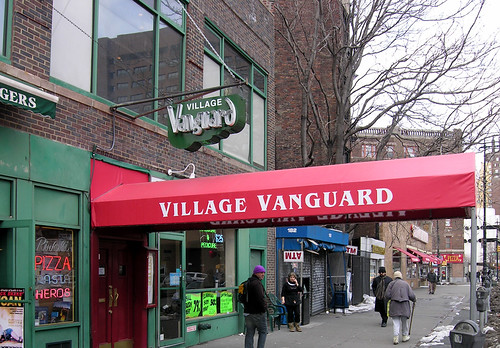 Could jazz clubs like the Village Vanguard be holding back the audience for jazz?
There has been much recent chatter in the blogosphere on the declining audience for jazz. In the Wall Street Journal this weekend, Terry Teachout points out that in the process of becoming a self-conscious art music during the middle of the twentieth century, jazz music became no longer "capable of appealing to the same kind of mass audience that thrilled to the big bands of the swing era." Peter Hum investigated a number of approaches to expanding the jazz audience on Thursday, including hybridizing jazz with other musical forms (an approach which yielded mixed results during the 1970s), promoting younger artists more heavily, and getting John Scofield into the next guitar hero game (which I think would be a great idea regardless of the implications on the audience of jazz). At A Blog Supreme, Patrick Jarenwattananon notes that attendance at all "high-cultural activity" is down (likely due in part to the economic crisis), but is nonetheless troubled by the shrinking audience.
I think jazz musicians can take a lesson from alternative comedy in expanding the audience. In the wake of the comedy boom of the 1980s, a number of comedians like David Cross, Janeane Garafolo, and Patton Oswalt began looking for new venues for stand-up. The idea was to perform where their audience would already be, rather than pulling their fans into the already-established network of comedy clubs. As Nathan Rabin of the AV Club put it, "Fans of Comedians mainstays Patton Oswalt and Zack Galifianakis are more likely to check out an indie band at The Troubadour than shell out $40 to see a Tonight Show regular play Señor Ha Ha's Laughatarium." So why not follow your fans to their native setting?
While this movement initially grew out of Los Angeles, alternative comedy scenes also began to flourish in Seattle, New York, Chicago, and a number of other cities. What is important to remember, though, is that instead of altering their acts to make them more palatable to younger audiences, these comics simply brought there acts to venues where young people who would otherwise like their material would go to see a comedy show.
I do not know if the "answer" to jazz's audience question will be to move performances to indie rock clubs (though some performers, like The Bad Plus and Medeski Martin & Wood, already play a number of gigs each year at these kinds of venues), but I am certain that the current jazz club paradigm repels a good number of people from live jazz. The club itself is a good atmosphere for jazz; small and intimate, enabling a personal connection between artist and audience. But it is not everyone's ideal. This is not a new criticism. Jazz clubs are expensive (one night I saw Kenny Garrett in Miami at the now-defunct Arturo Sandoval's Jazz Cafe, and paid a $30 cover with a two-drink minimum on top of that - and those two drinks were not cheap). Compare that to an indie-rock venue, where you can see a good band for $20 (and the beer is cheaper).
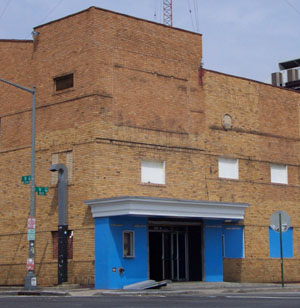 The 9:30 Club in Washington, DC, where you can see Son Volt, Mos Def, Janeane Garafolo, and The Bad Plus.
Jazz clubs are also not mixed-use. Most people listen to a variety of genres, and are more likely to attend shows at the same venue if it offers an eclectic range of performances. Jazz clubs, while housing a diversity of jazz artists, largely stick to jazz, which may limit the marketing possibilities for jazz. The 9:30 Club in Washington, DC, hosts a variety of acts ranging from hip hop to indie rock to standup comedy, as well as numerous points in between. It would seem like an advantage for the club itself to draw from diverse fanbases, and that at least a small part of the audience from a Mos Def show might be interested in seeing a jazz act at the same venue if they saw some promotional material (posters, flyers, etc.) for that act while at the Mos Def show (I believe the marketing term for this is cross-promotion).
Maybe we won't see thousands of budding young jazz fans flowing out from mixed-use venues like these, but it certainly would not hurt to try and expand the live-music model, which is limited mostly to jazz clubs and summer festivals. Jazz musicians may not reap the same rewards that alternative comics found, but they cannot wait around for their audience to find them, they must seek them out personally.
UPDATE: Howard Mandel thinks Teachout doth protest too much, while Jason Parker is onto something.
Vanguard photo via Professor Bop's flickrstream, 9:30 Club photo via Excess Void.
Subscribe to:
Posts (Atom)

