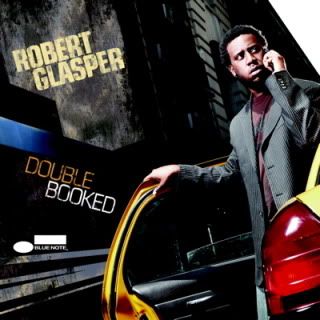
Occasionally when I listen to an artist that for some reason never entered my radar before, I am awarded a revelatory experience, after which I scramble to acquire as much of the artist's previous work as I can. Such is the case with Robert Glasper, the young pianist out of Houston who is causing quite a stir with his hip-hop-flavored jazz.
Like many young artists, Glasper's
Facebook page lists a variety of major influences on his music, interspersing rapper J Dilla and the renowned rock band Radiohead among pianists Thelonious Monk and Chick Corea. However, unlike most jazz musicians with such ecumenical tastes, Glasper actively reflects these artists' influence in his work (quite literally in his rendition of Monk's "Think of One,"
in which he quotes the chord progression to Ahmad Jamal's "Swahililand," a tune that provided the backdrop for De La Soul's "Stakes Is High").
Double Booked is a two-part album; the first featuring Glasper's acoustic trio with bassist Vicente Archer and drummer Chris Dave, the second featuring Glasper's Robert Glasper Experiment, a fusion band featuring Dave, saxophonist Casey Benjamin, and bassist Derrick Hodge. Neo-soul vocalist
Bilal also appears on the album's final two tracks.
The acoustic portion of the album plays up Glasper's subtle touch on the piano and spare compositions. The chord changes to "No Worries" and "Downtime" provide a rough frame for their respective melodies. Glasper's way of weaving in and out of the changes during his solos on these tunes is vaguely reminiscent of Keith Jarret, while his touch reminds me of Vince Guaraldi's skill at running up and down the keyboard.
Glasper's trio is on par with those of Jason Moran and Brad Mehldau, which is to say that it is as good as any. Archer and Dave match Glasper's ebb and flow intuitively, reflective of a group that is totally at ease in musical conversation.
The electric portion of the album finds Glasper in another vein entirely, presenting a fusion band adapted for the 21st century. The band reworks the Herbie Hancock classic into a futuristic spaced-out jam that recalls fusion-era Hancock filtered through the jamband
Vida Blue. Saxophonist Casey Benjamin manages to use the
vocoder in a way that doesn't make it seem like an antique. As with the melody from "No Worries," the music on Butterfly provides a cushoiny sonic backdrop on which Glasper lays down a far-reaching but constrained solo.
The final two tracks on the album, as mentioned above, feature neo-soul singer Bilal, who manages to blend with a band in a way that makes him seem like a fifth instrumentalist, rather than a singer in front of a backing band. Credit for this is due both to Bilal, who does not try to monopolize the musical space, and Glasper, who constructed a platform for Bilal's vocals which frames his singing well while also retaining interest for its own sake.
Jazz.com recently asked
if Robert Glasper can unite fans of jazz and hip hop. Perhaps Glasper is not explicitly aiming for this goal (I imagine his main intention is to simply create good music and sustain a fruitful career), but
Double Booked certainly has as good a chance of drawing hip hop fans into jazz as any album I can think of. That's a pretty good accomplishment if you ask me.
Track Listing: Intro; No Worries; Yes I'm Country (And That's OK); Downtime; 59 South; Think of One; 4eva; Butterfly; Festival; For You; All Matter; Open Mind
Personnel: Robert Glasper, piano, keyboards; Casey Benjamin, saxophone, vocoder; Vincent Archer Derrick Hodge, bass; Chris Dave, drums; Bilal, vocals
Image via this is tomorrow

 Today is the 83rd anniversary of John Coltrane's birth. It has been over 40 years since he left us, but his influence is still felt as well as being a topic of debate. Earlier this week, Peter Hum pointed out that despite Coltrane's deification since his death, there are still critics who bemoan his influence on the saxophone and modern jazz. At A Blog Supreme, Patrick Jarenwattananon discussed the difficulties inherent in playing Coltrane's music, namely, "How do you learn from him, but not sound like him?" These are both interesting discussions, ones that Ben Ratliff engaged with in his recent Coltrane biography
 . I'd like to consider the question of Coltrane's influence a bit more, but I'll have to listen to a bunch of records and think about this for awhile. In the meantime, there is the music...



