
Another year has come and gone. Just in case you missed it, below are links to my end-of-year and end-of-decade lists. See you in 2010...
Some Good Albums from 2009
Some Good Albums from the 2000s
Some Great Books from the 2000s
28 December 2009

24 December 2009
23 December 2009
Some Great Books From the Aughts
 Greetings from Miami, the perfect place to get away from a blizzard. We are living in a golden age of jazz studies, as musicologists, historians, journalists, and American Studies professors are all producing great works on jazz. Below are some of my favorite books on jazz from the past decade, all of which I highly recommend. This list is just a starting-off point, as I still have a ton of reading to catch up on (such is always the case with me I'm afraid).
- Robin Kelley: Thelonious Monk: The Life and Times of an American Original. I just finished this one last night, and it is awesome. I'll post a review of it sometime next week.
- Gabriel Solis: Monk's Music: Thelonious Monk and Jazz History in the Making (reviewed here). A perfect companion to the Kelley biography, Solis reveals how the music of Thelonious Monk could be utilized by such disparate figures as Wynton Marsalis and The Art Ensemble of Chicago to make competing statements about the nature of jazz.
- Ben Ratliff: Coltrane: The Story of a Sound. Combining biography and musical analysis, Ratliff tells us how Coltrane developed into the monolithic figure he has become and why his sound remains relevant 40 years after his death.
- John Szwed: So What: The Life of Miles Davis. The Interlude, in which Szwed unpacks the cultural significance of Miles circa 1960, is among the best essays I have ever read.
- Richard Cook: Blue Note Records: The Biography. This book is crucial to understanding the hard bop craze that shook up jazz during the late 1950s and continued paying dividends into the 1960s.
- Eric Porter: What Is This Thing Called Jazz?: African American Musicians as Artists, Critics, and Activists. An intellectual history of jazz, Porter tackles a number of subjects, including Ellington, Mingus, Braxton, and Marsalis, as thinkers as well as musicians, showing how what the writings of these and other musicians deepen our understanding of their music.
- Scott Saul: Freedom Is, Freedom Ain't: Jazz and the Making of the Sixties. Like Porter, Saul treats jazz musicians as intellectuals and artists, helping us understand the cultural and political stances which undergirded their music during the turbulent 1960s.
- John Gennari: Blowin' Hot and Cool: Jazz and Its Critics. Gennari has written a history of jazz criticism which I think is essential to decoding the writings of such luminaries as Leonard Feather, Nat Hentoff, and Martin Williams. You need to read this book.
- Penny Von Eschen: Satchmo Blows Up the World: Jazz Ambassadors Play the Cold War. A masterful warts-and-all history of the US State Department's deployment of jazz musicians across the globe as cultural ambassadors.
- Gary Giddins and Scott DeVeaux: Jazz
- Ingrid Monson: Freedom Sounds: Civil Rights Call Out to Jazz and Africa
- George Lewis: A Power Stronger Than Itself: The AACM and American Experimental Music
What did I miss? Let me know in the comments...
16 December 2009
An Open Letter To Senator John McCain
Dear Mr. McCain,
Since this is a blog post that you will probably never read, and since I still don't believe you know how to use a computer, I will skip the usual pleasantries. Instead, I will cut straight to the point. As Peter Hum and Jason Parker, among others, have pointed out, in your zeal to identify every misspent cent in the federal budget, you recently noted that Jazz at Lincoln Center received an $800,000 grant. You find this prospect to be wholly repulsive, it seems. "Next time you're in New York, go to the Lincoln Center," you said, adding sarcastically, "Jazz lovers rejoice."
I understand the principles of limited government which you hold dear (that is, when you are not calling for the escalation of foolish and unwinnable wars halfway around the globe which cost thousands of times more than these grants for jazz programs). Frankly, I agree with the assertion that the current economic crisis is the result of overextension in both the private and public spheres. However, as the old saying goes, you are being a pound foolish and a penny wise. With the 2010 federal budget deficit coming in at over a trillion dollars, it is simply asinine to be haggling over such a trifle as NEA grants.
I suggest you drop your vendetta against jazz, and try to balance the budget by focusing on programs that actually make a dent in the ledger (like outmoded weapons programs, for instance). Jazz is one of the most important cultural legacies of our republic, but you would not know it from the support (or lack thereof) it receives from our government. Moreso than just about every industrialized nation, the United States depends almost solely on the private sphere to fund and promote the fine arts. Judging by the status quo, you have effectively already won your battle to defund the arts. So leave us the hell alone and allow institutions like J@LC, the Monterey Jazz Festival, and the NEA to at least keep the pittance they receive from the federal government.
Most Sincerely,
David Hill
11 December 2009
Bonus Friday Album Cover
Yesterday Patrick Jarenwattananon informed us that Justin Vernon's (of Bon Iver) recent benefit performance with his high school jazz band was recorded and now is for sale. I haven't listened to any samples yet, but check out the album cover:
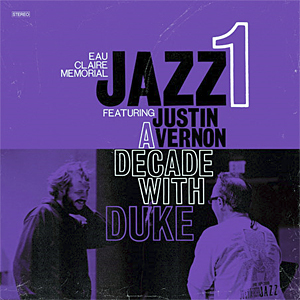 Referencing the Blue Note Special, but distinctive. Simple, but effective.
Subscribe to:
Posts (Atom)

