11 September 2008

iTunes Genius

Apple released the newest version of iTunes this week, which includes a new feature called Genius. Genius allows a you to automatically generate a playlist simply by selecting one song in the your iTunes library. As Apple explains in on their website,
Play a song, click the Genius button, and iTunes creates a playlist of other songs from your library that go great together. Genius playlists help you discover songs in your library you never knew you had — and rediscover forgotten favorites.
Genius hooks up your iTunes library to Apple's database of other iTunes users, and identifies songs that other users have bought or listened two in conjunction with the song you have selected. If any matching songs are in your library, then they are added to a playlist, which you can either save or discard. Resembling both Amazon.com's recomendations system and the popular web-radio site Pandora, Genius promises to mix up your listening habits and maybe turn you on to a forgotten or overlooked track in your library.

Interested in a shortcut that could give me some nice playlists, I tried it out. I used three jazz tracks to start playlists: Afro Blue by John Coltrane, Chameleon by Herbie Hancock, and Bachelor's III by Pat Metheny and Brad Mehldau. The Coltrane playlist best fit the things I would put on a list of my own, some Miles Davis, Kenny Garrett, and Freddie Hubbard, for instance. The Hancock list was all over the map, featuring the Quincy Jones Big Band, Billie Holiday, and Dexter Gordon, among some other fusion and 60s postbop. The Metheny/Mehldau playlist had some good choices that fit the mood of the track, like Bill Frisell, Kenny Garrett, and Michael Brecker selections, but some puzzling choices as well, including a Mahavishnu track. Every playlist had a few tracks I would remove if I saved the playlist, but all pulled in tracks that I would have put in my own playlists.

Genius is not without its programming issues. If you select a song that is not available for sale at the iTunes store (like anything from the Beatles' catalogue), then Genius will not create a playlist, giving a vague error message. The first song I tried on Genius, Horace Silver's "Song For My Father," came up with this problem. Hopefully, with Apple's library expanding rapidly, this problem will correct itself over time.

The major problem with Genius, though, is fairly evident to me. What happens if Genius puts something on a playlist that you don't want to include? When I created a playlist based on fusion-era Herbie Hancock, Genius included a Benny Goodman track. When you create a "station" on Pandora, you are given the ability to approve or dismiss any song suggested by Pandora. For instance, if I start a station with a Bad Plus track, I can select the thumbs-down icon if Pandora pulls up another track that I don't want to include a track by Rush. That way, I can steer the playlist towards fusion-oriented jazz and away from prog rock. It would be nice if such a feature could be worked into Genius. It gives the program a lot of versatility (see, for instance, how Howard Mandel created a "Jazz Beyond Jazz" playlist).

So Apple has some work to do to make Genius good enough to keep up with Pandora, but it will do for now...

05 September 2008

Friday Album Cover: Channel Three

Greg Osby
Channel Three


Greg Osby's 2005 Blue Note album Channel Three does not fit the Blue Note archetype (discussed earlier) at all. Other than the simple typography listing the artist and album title, there is almost no resemblance to the classic Reid Miles covers of the 1950s and 1960s. In many ways it is an anti-Blue Note cover: the cover is superimposed onto a vintage television screen, giving it a mixed-media feel. Additionally the image on the screen is really two images superimposed to resemble a busted television screen. There is also no hue to the black-and-white photo, which is a rarity for Blue Note covers.

Even so, the cover is in some ways a perfect fit for the album. Osby is playing in a pianoless trio (with drummer Jeff "Tain" Watts and bassist Matt Brewer), and plays the kind of dark, pensive music often associated with the romantic image of the jazz musician as a singular, contemplative individual (Think Sonny Rollins woodshedding on the Williamsburg bridge circa 1959). Osby is playing the type of music that makes you think of quiet, late nights alone with one's thoughts. Similarly, the dark image of a saxophonist on a tv with a broken picture, to me, conjures up a similar, somewhat desolate image of someone alone with his own thoughts.

04 September 2008

Update and Links

My posting has been a bit erratic (or absent) lately, and I will be back up to speed starting tomorrow with a Friday Album Cover.

In the meantime, check out Vintage Vanguard (h/t Dial M for Musicology). It is a Japanese site with a bunch of hi-res scans of Blue Note album covers, along with scans of the liner notes on the back of the cover. You could easily waste hours staring at all these covers and reading the notes. What a great find...Also, while it's still up, listen to two great cuts of avant-garde supergroup Air on Destination: OUT.

21 August 2008

Under the Radar: Genious + Soul = Jazz

Ray Charles

Supergroups rarely live up to expectations. For every Blind Faith, there are about ten Journeys (I still can't believe half that band was in Santana). So it is always a pleasant surprise when an all-star grouping lives up to expectations. Such is the case with Genius + Soul = Jazz, a collaboration between Ray Charles, Quincy Jones, and the Count Basie band. The album features Charles on the Hammond B-3 organ backed alternately by the Count Basie band (sans Basie) and by another group featuring Clark Terry, Budd Johnson, and Roy Haynes, among others. With charts arranged by Quincy Jones (who at that point was one of the key arrangers for Basie's "New Testament" band) and Ralph Burns (who cut his teeth writing arrangements for Woddy Herman's band), Charles was set up with some of the strongest personalities in jazz backing him on the album.

Genius + Soul = Jazz does not disappoint. The tracks with the Basie band swing hard, and the familiar comping of Freddie Green on guitar more than makes up for the abscence of Basie's piano. The other band also holds its own against Charles strong organ playing. Though he made a name for himself playing R&B, Charles had the chops to play jazz, and demonstrates his ability to the fullest on the album. "One Mint Julep," a song originally recorded by The Clovers, is a highlight, reaching No. 1 on the Billboard R&B chart in 1961, the year the album was released. Like many of the tracks on the album, "One Mint Julep" is an instrumental, allowing Charles to show off his organ chops. The tune blurs the line between jazz and R&B, in the vein of Lee Morgan's "The Sidewinder" or Cannonball Adderley's "Work Song." It is solid, workmanlike jazz with a driving pulse and memorable melody.

Also notable is "I'm Gonna Move To The Outskirts Of Town,"a slow-burning blues sung by Charles. Unlik much of his R&B vocals, Charles is subdued here, singing in almost a whisper. The effect is intriguing. We're used to hearing very powerful singers with the Basie band, think of Joe Williams or Jimmy Rushing. But Charles' soft timbre also works quite well against the Basie band, adding nuance to the band's famously powerful sense of swing. Charles also adds a heightened sense of drama to the tune by laying back.

While Genius + Soul = Jazz will not make many desert island lists, it is nonetheless a thoroughly entertaining album featuring a few of the most distinctive and soulful voices of jazz.

Track Listing: From the Heart; I've Got News for You Alfred; Moanin'; Let's Go; One Mint Julep; I'm Gonna Move to the Outskirts of Town; Stompin' Room Only; Mister C.; Strike Up the Band; Birth of the Blues; Alabamy Bound; Basin Street Blues; New York's My Home

11 August 2008

Friday Album Cover: Cookin'

Better late than never...
Miles Davis
Cookin' with The Miles Davis Quintet

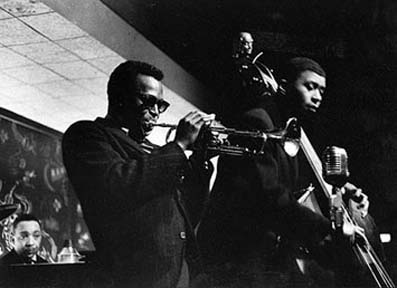
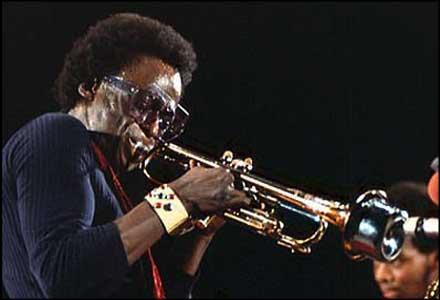
One of the many legends that arose from Miles Davis' life was the story that he would often turn his back on the crowd during a performance. This story is not so accurate; Davis often faced slightly askew from the audience in order to better communicate with his sidemen during performances. However, the story was often employed to prove one of two points, that he did not care about audiences' approval, or that while playing, he was intently focused on his music and did not want to be distracted. Though the former distorts more than it illuminates, the latter is an accurate assessment of Davis' onstage demeanor. A quick search through Google Images shows that while playing, Davis often had his gaze focused on his trumpet, as if he were trying to pull music out of his trumpet.

Miles' habit of staring at his trumpet was visually reproduced on the album cover of Cookin' with The Miles Davis Quintet. Designed by regular Blue Note contributor Reid Miles, the cover features a doodle of a trumpet seen through the eyes of Miles in mid-performance, by Phil Hayes. It's not a visually stunning piece of album art, but considering the muse, it is quite an apt piece of imagery.

Stats