Showing posts with label The Bad Plus. Show all posts

24 September 2010

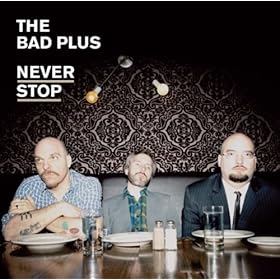
Review: Never Stop

The Bad Plus


I've discovered that it is pretty much impossible for me not to succumb to fan-boy admiration when writing about a Bad Plus album, so I'm going to go ahead and indulge myself with this here review. The Bad Plus have been together for ten years, and despite their (sometimes) treatment as a gimmicky group that covers Nirvana and Black Sabbath, they have attracted a fiercely loyal group of fans who never fail to express their love of the group (mention the band on Twitter sometime, you'll get a ton of replies from people you had no idea listened to jazz). Their latest album, Never Stop, celebrates the trio's tenth year of playing together. Unlike any of the band's past albums, Never Stop is comprised entirely of original tunes, with none of the adventurous covers of pop and rock tunes that were chiefly responsible for much of the trio's buzz in its early days.1

It is indicative of their charms that The Bad Plus can write tunes that evoke the intricate and driving melodies of prog rock icons like Rush or Emerson Lake & Palmer that absolutely hook me. This is all the more notable because I happen to abjectly despise those bands. On Never Stop, Beryl Likes to Dance falls into this category (and the best example of this type of prog-as-jazz tune is And Here We Test Our Powers of Observation from Give). However, the highlight of the album for me is the title track, which shares some of the proggy energy of Beryl (though, as bassist Reid Anderson pointed out in this interview at A Blog Supreme, the tune was actually composed for an Isaac Mizrahi fashion show for which the band performed a live soundtrack).

   The Bad Plus - Never Stop by dave6834

Many of the other factors which have come to characterize The Bad Plus are present on Never Stop: the tongue-in-cheek song titles (like My Friend Metatron), obscure signifying (Bill Hickman at Home is written for a legendary stunt driver), the slavish devotion to writing quality melodies (as in The Radio Tower Has a Beating Heart, which repeats a simple rubato melody with growing intensity for the first four minutes before turning the melody into a delightful little vamp for the final minute and a half), and the enthusiastic free jazz experimentation (see especially 2pm). It is as fitting a restatement of purpose as you would expect from a band which, despite criticisms from certain quarters of the critical establishment, has been developing its identity with flair for a solid decade. Here's hoping we can enjoy this group for decades to come.

Bonus Material: the EPK


1I'm actually pretty happy the band decided to eschew covers for this album. I've grown pretty tired of having to explain to my non-jazz-listening friends that The Bad Plus is more than "that jazz band that plays Nirvana tunes."

Track Listing: The Radio Tower Has a Beating Heart; Never Stop; You Are; My Friend Metatron; People Like You; Beryl Loves to Dance; Snowball; 2pm; Bill Hickman at Home; Super America
Personnel: Ethan Iverson, piano; Reid Anderson, bass; Dave King, drums

11 September 2010

Weekend Reading

Fall is coming...

09 October 2009

A Minor Corrective to the Jazz In Crisis Meme


Jazz fans are passionate to a fault, and us jazz bloggers even more so. In the wake of Terry Teachout's Wall Street Journal piece on the decline of the jazz audience, a whole host of bloggers have picked the piece apart, started a campaign to promote live jazz, and offered suggested albums to recommend to non-jazz listeners, among other responses. While the responses were thoughtful, they also (inadvertently) reveal a sense of defensive panic, as if we bloggers need to prove the vitality of jazz in the 21st century.

But I wish to offer a slightly more optimistic take on the situation. Instead of talking about the audience, I'll follow Patrick Jarenwattananon's lead and instead focus on the music. What is lost in the uproar over the audience is the fact that we are currently living in a golden age of piano trios. Not only are there a bunch of exciting groups putting out fantastic music, but the pantheon of these trios all have such an individual sound that even jazz neophytes can tell them apart. Below are just a few of the trios that are making the present moment such a satisfying one for jazz listeners.

Brad Mehldau Trio: Mehldau has loomed large over the jazz scene for over a decade, and his trio with bassist Larry Grenadier and drummer Jeff Ballard have put out a number of great albums over the last decade. I consider them the standard bearer of this group.


The Bad Plus
: Though we may be tempted to dub them enfants terribles for their deconstructive covers of pop and rock tunes, The Bad Plus are more of a postmodern edition of the traditional jazz piano trio.


Vijay Iyer Trio
: I'll let the rest of the jazz blogosphere do the talking here. I'll be giving their newest album, Historicity, a full review soon, but suffice it to say that it might be the best album of 2009. Iyer, bassist Stephan Crump, and drummer Marcus Gilmore have a fantastic musical rapport.


Keith Jarrett Standards Trio: The reigning master of repertory, along with bassist Gary Peacock and drummer Jack DeJohnette, will consistently knock your socks off with their discursive explorations of standards.


Robert Glasper Trio: Glasper gets a bit more pub for his Experiment band, but the acoustic trio is also a pretty good show.


Jason Moran's Bandwagon: Moran packs the entire history of jazz piano in his playing, but keeps it fresh and exciting. Bassist Tauras Mateen and drummer Nasheet Waits match him blow for blow in energy.


Medeski Martin & Wood
: Probably the most sui generis of this list, which is saying something. John Medeski usually sticks to electric instruments, but he is underrated on the acoustic piano.


Did I forget someone? Let me know in the comments...


Image via EyeShotJazz.

16 September 2009

My Jazz Now


A Blog Supreme is running a series called Jazz Now, in which the ABS team and friends recommend five albums each from the past ten years to nascent jazz listeners. For a complete explanation of the project, go here. Patrick Jarenwattananon kicked things off with his five today, and asked for audience participation as well. So below are the five albums I would recommend to somebody looking to get into current jazz, in order of date released.


1. Dave Holland Quintet: Prime Directive (2000). Holland is the Art Blakey of the modern postbop scene, assembling an array of talented younger players to augment his bands, which have become a kind of graduate school in jazz performance.


2. Jason Moran: Modernistic (2002). Moran's reimagining of the James P. Johnson classic "You've Got to Be Modernistic" is worth the price of the disc alone. Moran has an uncanny ability of packing the entire history of jazz piano into his style while keeping it fresh and surprising the listener at every turn.


3. Happy Apple: Youth Oriented (2003). As I wrote in this space last year, Happy Apple
expands the boundaries of jazz, incorporating rock and avant-garde influences while allowing plenty of room for individual and group improvisation. Their work is often exhilarating, and very rewarding to those who can stomach a little chaos.

4. The Bad Plus: Prog (2007). The Bad Plus appear to be a popular group for these lists. These Are The Vistas is my favorite album of theirs, but that one has been chosen by a few people already, so I will go with Prog instead, which features some choice covers and great originals.


5. Robert Glasper: Double Booked (2009). I'll be posting a review of this album later in the week, but suffice it to say that I've already recommended this album to a few friends who don't really listen to much jazz.

Honorable Mentions
The Bad Plus: These Are The Vistas
Paul Motian: Time and Time Again
Darcy James Argue's Secret Society: Infernal Machines
Medeski Martin & Wood: Tonic
Chris Potter: Follow the Red Line
Wayne Shorter: Footprints Live


You can read the entire Jazz Now series at A Blog Supreme (image via NPR).

04 February 2009

Review: For All I Care

The Bad Plus Joined by Wendy Lewis
For All I Care


Since first being acknowledged by mainstream media outlets, The Bad Plus have been tagged with the unfortunate label of the Jazz Trio That Covers Popular Songs (see, for instance, this NPR profile from 2003). This is unfortunate on multiple levels. The band is comprised of serious (and seriously talented) musicians who take great care in their choice of repertoire (i.e. they do not play covers for the sake of playing covers, but because they can make an interesting artistic statement by doing so). Focusing on their covers also ignores the fact that all three band members (Reid Anderson, Ethan Iverson, and Dave King) can write good tunes (see, for example, "Big Eater" from These Are the Vistas and "And Here We Test Our Powers Of Observation" from Give, both written by Anderson).

Besides being (unfairly, in my opinion) tagged as a covers band in some quarters, The Bad Plus have been further misunderstood by writers who claim their usage of covers is simply a snarky attempt at irony. The band addressed this misconception directly on their blog (read it here), so I won't belabor the point, but suffice it to say the characterization of the band as ironic jesters misses the mark.

With that in mind, I was surprised to find out that the band's newest album, For All I Care, would not only be comprised entirely of covers, but would also feature a vocalist, Wendy Lewis. For a jazz ensemble that's had to deal with the stigma that comes along with covering pop tunes, this is an unexpected turn of events.

That is not to say that I did not like the album. Like much of their other work, For All I Care features the same inventive take on familiar material as their other albums. One of the most impressive traits of The Bad Plus is the way they make covers their own. If you weren't familiar with any of the tunes on the album, you would be forgiven for assuming they were written by any of The Bad Plus. Of course, if it were up to me, I would have cut a few tracks off of this album to make room for a few originals from any of the band members.

Perhaps the most intriguing aspect of the album is the way the band utilizes Lewis' vocals. Instead of placing her at the forefront of the group, she instead serves as somewhat of an accompaniment to the counter-melodies and rhythmic figures running underneath the band's arrangements. Before listening to the album, I wondered whether Lewis would steal too much of The Bad Plus' thunder, but for the most part, she fits in well. Her soft-burning vocals on "Comfortably Numb" give the band ample room to roam, while "Radio Cure" allows for plenty of room for exploration between verses.

Another reviewer lamented that by adding vocals, the band lost "the advantage of leaving the words behind, allowing them to shape things in any number of directions." But such a comment ignores the fact that these covers are not about ironic deconstruction, but earnest renderings of cherished material. Like Brad Mehldau, another young musician unafraid to tackle contemporary pop tunes and classic rock, The Bad Plus deftly toes the line between presenting these covers in a familiar context and exploring the creative possibilities inherent in the tunes.

However, the problem with performing covers is the baggage inherent in song selection. While the members of the band (presumably) all like the songs they choose to perform, the same cannot be said of the audience. It doesn't matter what the band does with the tune, I will probably never like "Barracuda." This does not make their rendition of the tune any less satisfying, but it nonetheless detracts from the album somewhat (for me, at least). Indeed, among the highlights of this album for me were the tunes with which I was not familiar, like Stravinsky's "Variation d'Apollon" and Milton Babbit's "Semi-Simple Variations." Nonetheless, For All I Care serves as a welcome addition to The Bad Plus' discography that newcomers and seasoned fans of the group alike would enjoy.

Track Listing: Lithium; Comfortably Numb; Fém (Etude No. 8); Radio Cure; Long Distance Runaround; Semi-Simple Variations; How Deep Is Your Love; Barracuda; Lock, Stock and Teardrops; Variation d’Apollon; Feeling Yourself Disintegrate
Personnel: Ethan Iverson, piano, bells; Reid Anderson, bss, vocals; Dave King, drums, vocals; Wendy Lewis, vocals


BONUS: Read Ethan Iverson's piece from last month's
Jazz Times on adapting modern classical repertoire for The Bad Plus has been posted on the band's blog. Read it here (the piece is below the photos).

Bonus Material

Via YouTube, here's a video of The Bad Plus performing U2's "New Year's Day" with Wendy Lewis in Moscow last December. The audio isn't great, but it is nonetheless a stunning performance.


On an unrelated note, many thanks to Jazz@Rochester for linking the blog this week. Keep up the good work...

21 December 2008

Wynton Marsalis is the Ronald Reagan of Jazz - Not That There's Anything Wrong With That

On Monday morning I awoke to find a wonderful surprise on my RSS reader: a panoply of new posts on Do The Math examining the Young Lions of the 1980s and the jazz wars of that decade, as well as an extensive interview (and blindfold test!) with Wynton Marsalis. What a great early holiday gift from Ethan Iverson. Do yourself a favor and skim through some of the goods. Some of the material delves into historical and musical minutiae that only a specialist can really understand, but there are plenty of tidbits that will entertain even casual jazz fans.

The material as a whole brought to my mind a thought I had explored somewhat deeply during my time in graduate school. During that time, when I was mentally plotting out possible dissertation topics, I explored the idea of writing a cultural history of jazz that effectively contextualized the music in American thought and culture. Basically, I thought I would rewrite Jazz in American Culture my way. One chapter idea for the dissertation which received much contemplation was a study of Wynton Marsalis' rise to prominence during the 1980s. The idea in my mind was to connect the forces surrounding the rise of Marsalis to those surrounding the rise of Ronald Reagan.

Calling Wynton Marsalis the Ronald Reagan of jazz is not a new idea. Indeed, invoking Reagan in the pejorative sense had become somewhat of a favored mode of attack in the jazz wars. Shortly after the Ken Burns Jazz documentary aired in 2001, this screed made the rounds on the internet, in which saxophonist Mike Zilber issued a number of pronouncements against Marsalis (who was a major consultant to and presence in the documentary), Burns, and the documentary itself. The charges themselves are mostly not worth repeating, since you can read the entire piece on this page and anyone familiar with the controversy around the document is well aware of the points made in Zilber's critique.

But my idea was to examine the connection between Reagan and Marsalis in a non-pejorative, inquisitive manner. Indeed, Reagan's name carries with it an almost inconceivable amount of baggage, as this year's election cycle showed us time and again. However, if you look past the mythology built around Reagan and examine the personal feelings behind his ideology and how he resonated with a large coalition of voters in 1980, I think you will find more than a few interesting similarities between he and Marsalis that help explain Marsalis' own rise to prominence as well as the "renaissance" of jazz he helped lead in the 1980s.

The lazy critique of Marsalis posits that he does not like a lot of jazz made during the 1960s and 1970s. His detractors point out that Marsalis has never paid tribute to Marion Brown or Keith Jarrett at Jazz at Lincoln Center the way he has to Duke Ellington or Charlie Parker. This, they argue, shows his hand. As Mike Zilber put it,
Marsalis is now the Ronald Reagan of jazz and, like Reagan, has no memory of those nasty 60s and 70s, preferring to bask in the halcyon days of Roseland, Satchmo and wax recordings.
Though Zilber and others have overstated this fact, it is still important to note that Marsalis feels and is not afraid to argue that much of the music produced and marketed as "jazz" during the 1960s and 1970s is not jazz. More specifically, Marsalis has argued many times that two strains of American jazz - the experimental avant-garde and jazz-rock fusion - should not be considered jazz (he would call both styles "improvised music" instead). This, not surprisingly, rubs many musicians, critics, and fans the wrong way.*

Marsalis has made two arguments for these exclusions. The first, which Wynton expresses in his DTM interview, and which his intellectual godfather Stanley Crouch has repeated elsewhere, is that by succumbing to inclusion ad infinitum, the word jazz loses its meaning. Instead, Marsalis argues, one must draw the line somewhere. For Marsalis, swing is one of the essential traits of jazz (the blues aesthetic is another), so any evaluation of what is or is not jazz begins by determining whether the music in question swings (though it should be noted that Marsalis' tastes seem to have broadened over the past 15 years).** As Iverson argues in his DTM posts, Marsalis and his contemporaries fetishize swing to an astonishing degree. Avant-garde jazz and fusion do many things, but they do not swing the way Marsalis and his peers swing. So it is not surprising why Marsalis would argue for the exclusion of those styles from The Jazz Tradition.

The second reason speaks both to cultural politics and musical analysis. In Monk's Music: Thelonious Monk and Jazz History in the Making (Roth Family Foundation Music in America Imprint), Gabriel Solis explains Marsalis' has description of the 1960s and 1970s as a time when some jazz musicians lost their way. The historical trajectory of jazz was altered when a number of musicians followed the trails of either the avant-garde or fusion. Both styles were not jazz. Fusion was no better than rock music. As Wynton put it "If you were there it was a great way to meet women and have a good time... but it's a death toll for jazz musicians." And the avant garde was also decidedly non-jazz. It was merely "a reaction to the European avant-garde," which sacrificed The Jazz Tradition for the sake of innovation. Because so many musicians fell under the spell of fusion or the avant-garde, jazz ceased to exist as an artistic musical expression that also captured the ears of a substantial audience, according to Marsalis.

Marsalis sought to return jazz to this cultural moment at which jazz could be both accessible and elevated to high art status. He and the Young Lions brought a renewal to jazz following these musical upheavals of the 1960s and 1970s. The excesses of the avant-garde and the crass comercialism of fusion were to be cast aside for jazz that built upon a tradition that was artistic but did not innovate for the sake of innovation. It can easily be described Morning in Jazz if you wanted to make reference to Reagan.

Marsalis was successful. He became enough of a cultural zeitgeist to appear on the cover of Time and secure his appointment as Artistic Director of Jazz at Lincoln Center, where he institutionalized his program of jazz renewal. But not only that, he created great jazz that itself should be included in The Jazz Tradition. On DTM, Iverson restates the case for Marsalis Standard Time ~ Vol.1, J Mood, The Wynton Marsalis Quartet Live At Blues Alley, and Black Codes (From the Underground), and I heartily second. He may have touched off the Jazz Wars in the process, but he would argue that he also helped blaze the path for creating The Jazz Tradition.

This story of renewal following two decades in the wilderness is oddly reminiscent of the narrative employed by Ronald Reagan in 1980, just around the same time Marsalis began his apprenticeship with Art Blakey and the Jazz Messengers. Reagan saw the politics of the 1960s and 1970s much in the same way Marsalis saw the jazz of those eras. The major thenes of Reagan's 1980 Presidential campaign included critiques of the boated welfare state of the 1960s, the loss of momentum in the Cold War at the hand of detente during the 1970s, and the permissive youth culture of both decades. As Marsalis perceived his music as a renewal of jazz, Reagan presented his platform as a vehicle of American renewal (whether he achieved it or not is a whole other story).

Like Reagan, Marsalis consolidated his ideas into a movement, creating a template for his own school to follow and for his detractors to criticize. Both men placed themselves in important historic moments, at which point they were to lead the public on a historical trajectory. Both are at the center of debate in their respective fields almost thirty years afterward, in the 2008 Republican Presidential primaries in Reagan's case, and in the postmortem of the Jazz Wars in the case of Marsalis. So aside from being a superficially biting critique of Marsalis, the comparison to Reagan also reveals much about the way Marsalis may perceive of himself in jazz history.

--

Big h/t and a heartfelt thanks for being who they are to: The Bad Plus (DTM)

For more on Marsalis, see Eric Porter, What Is This Thing Called Jazz?: African American Musicians as Artists, Critics, and Activists, pp. 287-334 and Gabriel Solis, Monk's Music: Thelonious Monk and Jazz History in the Making, pp. 150-151.

*There is an undeniable amount of resentment inherent in these critiques of Marsalis. As Artistic Director of Jazz at Lincoln Center, he is in a particularly powerful position as the preeminent tastemaker of American jazz. Certainly, most of his critics would enjoy that kind of critical power.
**
Marsalis postulates this theory, which he calls the "purist ethic in jazz," in a 1988 op-ed piece for the New York Times, "What is Jazz - And Isn't." Iverson summed up a major critique of this position brilliantly in his DTM post, writing that to his detractors, Marsalis appeared to have "a unified disdain for jazz music that wasn’t swinging, virtuosic, and informed only by the great black jazz musicians comfortable with chord changes."

11 October 2008

Under the Radar: Happy Apple

Happy Apple

Where to begin?

If pressed to describe them in two sentences or less to someone who had never heard of them, I would call Happy Apple a band that fuses the avant-garde style of Air with a punk sensibility. But, like most abbreviated descriptions, this does not do the group justice. Comprised of saxophonist Michael Lewis, bassist Eric Fratzke, and drummer David King (of The Bad Plus), Happy Apple is an exciting band that does not deserve the unfortunate "side project" designation.

On Youth Oriented, the trio's fifth album (and first on a major label), the group presents ten originals which expand the boundaries of jazz while allowing plenty of room for individual and group improvisation. Typical of their approach is Lewis' "Green Grass Stains on Wrangler Jeans," a 5/4 tune with a subdued melody. After dispensing with the head, Lewis begins soloing, but, as Fratzke puts it,
We're not just the drummer and the bassist backing the big bad-ass soloist. We strive as a group to communicate as a single entity, not just laying back until it's time to solo.
King pushes and pulls on the beat with his frenetic drumming under Lewis, while Fratzke holds everything together.
Whereas Happy Apple kept things light and subtle on "Grass Stains," the boys lay it on thick on "Salmon Jump Suite." Lewis gives the opening salvo forcefully, and Fratzke and King join him in a rollicking melody, mixing atonal phrases with bluesy Ayleresque blues riffs. The effect is jarring, it is as if the Stooges played jazz. Fratzke weilds his bass like Les Claypool, hammering on an electric bass with a guitar pick for extra emphasis. Underlying this is King, who stays just ahead of the beat despite pounding on the kit. The song is over in an exhilarating three minutes and thirty-seven seconds.
Lewis, Fratzke, and King are kindred spirits; exploring rhythms and sounds of multiple genres while pushing the outer regions of tonality in a captivating manner. They keep things fresh and exciting on "Youth Oriented," and are, in the words of Ellington, beyond category.

Track listing: Youth Oriented; Green Grass Stains on Wrangler Jeans; The Landfill Planetarium; Salmon Jump Suit; Drama Section; The Treetops of a Bad Neighborhood; It Will Be; Creme de Menthe Quasar; Youth Oriented
Personnel: Michael Lewis, saxophone; Erik Fratzke, bass, guitar; Dave King, drums

09 October 2008

List: New Standards

This week at jazz.com, Matt Leskovic listed twelve tracks in which contemporary musicians used recent popular music for new perspectives. His list was pretty good, but I thought I would suggest a few alternates.

1. The Bad Plus, Flim

Leskovic was right to select The Bad Plus, who have offered many takes on their favorite pop music, but none work better than Aphex Twin's "Flim." Included on their first album, These are the Vistas, the tune showcases David King's energetic drumming.

2. Medeski, Scofield, Martin & Wood, Sticks and Stone

Here is a great case of a group reworking a pop tune into thier own milieu. From Scofield's album of Ray Charles tunes, What'd I Say, Medeski, Martin & Wood join the guitarist and meld Charles' tune into their signature brand of avant-garde funk. Coming in at a quick four minutes, this tune gets the job done in an exhilarating hurry.

3. Brad Mehldau, Everything In Its Right Place

Paranoid Android is a great track, but I prefer a different Radiohead tune from his album Anything Goes.

4. Medeski, Martin & Wood, Everyday People

From their album Combustication, MMW take the Sly Stone classic at a slow burn. MMW was the single biggest glaring omission from this list. MMW have always enjoyed signifying on popular material, covering such diverse acts as Jimi Hendrix, Ray Charles, and King Sunny Ade.

05 October 2008

Sorry

No new content in a week, but it was a busy week, so sorry. I'll have something up soon, in the meantime, listen to The Bad Plus...


02 August 2008

List: Best Working Groups in Jazz

One of the things I like about jazz is the ease with which total strangers can come together and play quality music with little or no rehearsal, thanks to the shared language of jazz. As a result, supergroup recordings abound in this art. If a few star performers want to get together to produce an album, the only thing standing in their way is scheduling. However, though the possibility of fantasy groupings will perpetually tantalize jazz fans, the fact remains that in jazz, the intimacy afforded by regular work together facilitates artful music. As such, much of the best jazz produced comes at the hands of a longstanding working groups, whose musicians know each other as well as they know themselves.

So without further ado, below are my favorite current working bands, in a completely random order, with a recommended recording thrown in for good measure:
  1. Dave Holland Quintet (Robin Eubanks, trombone; Chris Potter, saxophone; Steve Nelson, mallets; Holland, bass; Nate Smith, drums): The lineup has shifted a bit in the past few years, with Smith replacing Billy Kilson on drums, but the fact remains that this group plays some of the most exciting music in jazz. The group excels at collective improvisation, and the interplay between Eubanks and Potter is often exquisite. Check them out on Extended Play, a double live disc from 2003.
  2. Medeski Martin & Wood (John Medeski, keyboards; Chris Wood, bass; Billy Martin, drums, percussion): Though some may argue that this group does not actually play jazz, I disagree. Electric or acoustic, this trio can swing with the best of them (in their inimitable way) and brings an incredible sense of energy to their music. I recommend Tonic, a live acoustic album from 2000.
  3. The Bad Plus (Ethan Iverson, piano; Reid Anderson, bass; Dave King, drums): The band has yet to release a live album in the U.S., so I've embedded a YouTube clip below of a live performance. I also heartily recommend the band's blog.
  4. Wayne Shorter Quartet (Shorter, saxophone; Danilo Perez, piano; John Patitucci, bass; Brian Blade, drums): Like many of the other bandleaders in this list, Wayne Shorter has pulled off the impressive coup of hiring sidemen who all lead stellar groups of their own. Whether reimagining Shorter's compositions or playing newer material, this quartet is not afraid to explore and reach outside of their comfort zone to produce great art. Shorter's quartet excels on the live discs Footprints Live! and Beyond the Sound Barrier.
  5. Void (Troy Roberts, saxophone; Tom O'Hallaran, keys; Dane Alderson, bass; Andrew Fisenden, drums): You probably have not heard of them, but this group from Australia can play. They do not perform regularly anymore (which should disqualify them from the list, but I make the rules, so they're in), but when they do get together, it is an event of epic proportions. Check out their website, and give them a listen.
  6. Pat Metheny Trio (Metheny, guitar; Christian McBride, bass; Antonio Sanchez, drums): As I've written in this space before, Pat Metheny thrives in the trio setting due in no small part to the fact that he can surround himself with some of the best musicians around. I saw this trio play in Gainesville, Florida in 2005, and it totally hooked me on Metheny. I had never been a huge fan of his, but after seeing him live (for $10 - thanks UF student government!), I could not get enough Metheny. Be sure to check out the recent live EP Tokyo Day Trip.
  7. Keith Jarrett Standards Trio (Jarrett, piano; Gary Peacock, bass; Jack DeJohnette, drums): When Jarrett is not being an insufferable ass, this group produces more moements of surprise and genius with well-worn standards in one night than most groups could hope to make over a career. Along with Wynton Marsalis' championing of standards around the same time, this group made standards cool again, and we have them to thank for reinvigorating the genre. They have so many quality live performances out there for sale, but two of my favorite are Whisper Not, from 2000, and Inside Out, from 2001.
The Bad Plus: Flim

27 June 2008

Friday Album Cover: These Are the Vistas

The Bad Plus
These Are the Vistas

This week, coinciding with their quartet performance with Kurt Rosenwinkel (review), we will be looking major-label debut of The Bad Plus, These Are the Vistas. Easily my favorite Bad Plus album (I could listen to an endless loop of "Big Eater" and their cover of "Flim"), the cover presents a simple portrait of a robot vaguely reminiscent of R2D2. The notes to the album inform us that the robot is named Robonaut, who is (perhaps) "alone on a distant outpost in space, talking into the void." Since I'm being lazy this week, I won't add any other comments.

One final note: If you haven't already, be sure to check out The Bad Plus' blog, Do the Math. It's a winner.

Stats