
--
Showing posts with label John Coltrane. Show all posts
Showing posts with label John Coltrane. Show all posts
01 September 2011

08 July 2011
25 February 2010
15 February 2010
Remembering the First Miles Davis Quintet
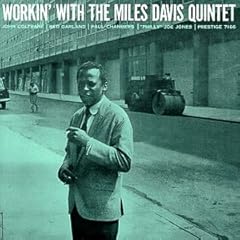 This weekend's post on Red Garland and Charlie Parker at JazzWax had me reminiscing about the mid-1950s Miles Davis quintet with Garland, John Coltrane, Paul Chambers, and Philly Joe Jones. Back when I was initially exploring jazz in middle school and high school, this band was the first of the canonical ensembles that I fell in love with. Having read a glowing review of Workin' With the Miles Davis Quintet in a book I had, I quickly bought copies of it and three other albums, Steamin', Cookin', and Relaxin', all of which were recorded over two sessions in 1956 as Miles wanted to fulfill obligations with Prestige Records before recording with Columbia. They were among the dozen or so albums that I listened to continually in high school as I developed my taste in jazz. Miles' playing during this period was also a major influence on my jazz improvisation at the time (I was quite taken by his lyricism, and leaned on him heavily as I developed my own sense of melodicism).
In his autobiography, Miles remembers that this band made him a star:
Wherever we played the clubs were packed, overflowing back into the streets, with long lines of people standing out in the rain and snow and cold and heat. It was something else, man, man. And a whole lot of famous people were coming every night to hear us play. People like Frank Sinatra, Dorothy Kilgallen, Tony Bennett (who got up on the stage and sang with my band one night), Ava Gardner, Dorothy Dandridge, Lena Horne, Elizabeth Taylor, Marlon Brando, James Dean, Richard Burton, Sugar Ray Robinson, just to mention a few.The band earned this star power, to be sure. Miles remembers "It was so bad that it used to send chills through me at night, and it did the same thing to the audiences, too." Miles had just recently made his mythologized "comeback performance" at the 1955 Newport Jazz Festival, playing Monk's 'Round Midnight to a captivated crowd. He had also kicked his heroin habit just before this period, and he had found a new energy which drove him to conquer the ears of jazz listeners. He had one of the all-time great rhythm sections behind him: The swinging Red Garland on piano, whose block chords and light touch glued the rhythm section; the fiery Philly Joe Jones on drums, who felt what Miles was thinking, and who Miles described as "the fire that was making a lot of shit happen;" and the extremely hip Paul Chambers on bass, who could make quarter notes swing like you could not believe.
Then there was Coltrane, commonly described as a diamond in the rough during this period in jazz histories. He was still putting his improvisational style together; it was only after his stint with Thelonious Monk a year later that he really sounds like the Coltrane who was the king of jazz in the early 1960s. But his often unmoored, searching solos managed to confound me and captivate me, though I only later really understood what he was trying to do at the time. And Miles himself was on top of his game, fragile and beautiful when playing ballads with a Harmon mute and powerfully melodic when playing without the mute. This band is overshadowed by Miles' later quintet with Herbie, Ron, Tony, and Wayne, but even 50+ years after these recordings were made, they are still engaging to contemporary ears.
The repertoire on these four albums balanced Miles' originals with standards that the band used at clubs regularly, allowing them to use the first complete take of each tune at the sessions. Sadly, a quick YouTube search yields no video of this band, but plenty of audio excerpts from these albums, which follow after the jump.
23 September 2009
Dear John
 Today is the 83rd anniversary of John Coltrane's birth. It has been over 40 years since he left us, but his influence is still felt as well as being a topic of debate. Earlier this week, Peter Hum pointed out that despite Coltrane's deification since his death, there are still critics who bemoan his influence on the saxophone and modern jazz. At A Blog Supreme, Patrick Jarenwattananon discussed the difficulties inherent in playing Coltrane's music, namely, "How do you learn from him, but not sound like him?" These are both interesting discussions, ones that Ben Ratliff engaged with in his recent Coltrane biography
 . I'd like to consider the question of Coltrane's influence a bit more, but I'll have to listen to a bunch of records and think about this for awhile. In the meantime, there is the music...
Photo via Jazz In PhOto
13 August 2009
Rashied Ali
 Rashied Ali has died at the age of 74. Ali was a major player in the avant garde scene of the late 1960s, replacing Elvin Jones in the drum chair of John Coltrane's group and also playing with Paul Bley and James "Blood" Ulmer, among others. He had not slowed down in the winter of his years, his trio with alto saxophonist Charles Gayle and bassist William Parker, dubbed By Any Means, played at Newport last weekend.
Hot House readers are recommended, nay required to listen to his work on Coltrane's Interstellar Space
 . Below is Venus, which Joe Lovano reviewed for Jazz.com recently:
In a way, Rashied Ali was playing more like a soloist along with the soloist, but they were finding all kinds of beautiful unisons within the counterpoint that they were creating with each other.

Image via JazzTimes
03 July 2009
Must Read
 In The Weekly Standard, Joe Queenan tells a tale of former Federal Reserve Chairman Alan Greenspan's days as a jazz musician. Some choice quotes follow. Greenspan brought a distinctive approach to improvisation, as told by Snooky Parnell:
"The Green Man [his nickname at the time] always played his arpeggios back to front, and in the subtonic key, which forced the listener to rethink his assumptions about where a solo should go," recalls Parnell, who played bass with Miles Davis, Art Tatum, and Thelonious Monk.He also played well enough to impress Charles Mingus, who invited Greenspan to tour Europe with his octet after sitting in one night in San Francisco. But Greenspan could not handle the thought of not being the best saxophonist around, an insecurity which eventually led him to quit the music business:
It was September 14, 1949, and Greenspan found himself in the same Greenwich Village club as John Coltrane. Coltrane, a convivial sort, went out of his way to be friendly to the youngster, but Greenspan was having none of it. Sax at the ready, he challenged Coltrane to an onstage showdown. It was a mistake he would regret for the rest of his life.Read the full piece here.
"Trane smoked his ass," Parnell remembers. "Greenie foolishly tore into 'Cherokee,' Charlie Barnet's old standby, but Trane knew that tune inside out from his days in Kansas City. Greenie tried to keep up, but no chance. Trane didn't rile easily, but something about the way Greenie carried himself didn't suit John. Trane took him apart."

h/t: jazz.com
18 March 2009
Review: Compass


In 2007, when he released Back East
 , Joshua Redman automatically drew comparisons to Sonny Rollins and Ornette Coleman for his use of a pianoless rhythm section. Daunting as these comparisons may be, he was nonetheless hailed for making "the most agile and personal record of his career," in the words of Ben Ratliff. Having found artistic success in this format, Redman returns to the pianoless trio for his latest album, Compass. Leaving out the piano adds spontenaity to his music, as he told NPR in 2007:
It's a tremendously liberating format, because there's no piano, no dedicated melodic instrument, it gives me and the other musicians so much room to experiment and explore, both melodically and harmonically. But with that freedom comes an awful lot of responsibility.On Compass, Redman ups the ante by doubling the bass and drums on some of the tracks, platooning Larry Grenadier and Rueben Rodgers on bass and Gregory Hutchinson and Brian Blade on drums. As with Back East, Redman's goal is to free up his own playing, eliciting spontaneous explorations of harmony and melody. On many tunes, Redman adroitly toes the line between outside and inside playing, stepping just outside the chord changes long enough to make the listener notice, but returning to the changes in enough time to keep the tune's melody within sight.
As with many current saxophone records, Compass can at times sound a bit too much like some of its influences. "Hitchhiker's Guide" sounds suspiciously like the opening of Sonny Rollins' Freedom Suite. "Identity Thief" sounds like the kind of tune Ornette Coleman would have written in the early 1960s. This would be a problem if Redman did not leave his personal stamp on the tunes, but by the end of each tune, you are left with no doubt who is on saxophone.
A highlight of the album is "Insomnomaniac," a melody featuring repeated, clipped phrases played over a manic groove. It is an apt title, as the melody features a pastiche of thoughts and phrases familiar to anyone who has lied awake at night for hours at a time. The tune shifts between multiple tempos, and Redman's trio constantly refers to the main melody, like someone with a troubling thought on his mind. He brings a heightened sense of drama to his solo which serves the tune well.
"Identity Theif" also struck my interest. Redman utilizes both bassists and both drummers on this tune, which sounds practically harmolodic to my ears. Grenadier and Rogers play off of each other nicely, as do Blade and Hutchinson. In fact, if you were to listen to this tune on a monaural sound system, you might not be able to tell that there are four rhythm players on the track due to the cohesiveness of the group.
However enjoyable these tracks are, though, I cannot escape the feeling that something was lost in the process of recording the album. This weekend, I saw Terence Blanchard play a guest-artist concert with the University of Virginia jazz ensemble, and the experience reminded me how little of an impression his studio albums left on me compared to seeing him live. There is some quality to his studio work that prevents his albums from leaving much of an impression on me. Compass shares this trait, unfortunately. I can listen to it and enjoy it, but the album does not captivate me. This is not intended as a criticism of Redman. Indeed, maybe the problem is me. Nonetheless, when I listen to Compass, I can't help but think that I don't enjoy the album as much as I should. Such are the idiosyncracies of life sometimes...
Track Listing: Uncharted; Faraway; Identity Thief; Just Like You; Hitchhiker's Guide; Ghost; Insomnomaniac; Moonlight; Un Peu Fou; March; Round Reuben; Little Ditty; Through the Valley
Personnel: Joshua Redman, saxophone; Larry Grenadier, Reuben Rogers, bass; Gregory Hutchinson, Brian Blade, drums
15 January 2009
List: 1959: Before and After
Being that 1959 saw the release of so many landmark jazz albums (Kind of Blue, Time Out, Giant Steps, The Shape of Jazz to Come, etc.), plenty of writers will be profiling the golden jubilees of all these albums throughout the year. But focusing on 1959 misses the point of that era. While 1959 was certainly a great year for jazz, the years surrounding 1959 all created their fair share of classics canonized in The Jazz Tradition. Since the late 1950s and early 1960s were a veritable golden age for jazz, when young lions like Coltrane and Coleman were reshaping the music while older stars like Ellington and Hawkins were still thriving, lets not limit ourselves to remembering 1959 as a watershed moment. Below are some great albums from 1958 and 1960 which are sometimes overshadowed by the weight of 1959.
A quick note: I am classifying these albums by the date they were recorded. Some were released the year after they were recorded, but the way things were changing in the jazz world at this time, a musician could sound much different over the space of a year (such is the case especially with John Coltrane).
1958:
UPDATE 2: Kevin Kniestedt offers his thoughts on 1959 at Groove Notes.
A quick note: I am classifying these albums by the date they were recorded. Some were released the year after they were recorded, but the way things were changing in the jazz world at this time, a musician could sound much different over the space of a year (such is the case especially with John Coltrane).
1958:
- Bill Evans, Everybody Digs Bill Evans. Featuring an interesting album cover, Everybody Digs Bill Evans effectively introduced Evans to the jazz world just as he was to join Miles Davis' quintet at the piano chair.
- Cannonball Adderley, Somethin' Else. One of the classic hard bop records, Cannonball was joined by a veritable all-star band featuring Miles Davis, Art Blakey, Hank Jones, and Sam Jones. Adderley firmly established his reputation as a prominent figure in jazz with this record.
- Ornette Coleman, Something Else!!!!. One of the few albums in which Coleman used a piano player (Paul Bley in this case), Something Else introduced the world to Coleman before his infamous residency at New York's The Five Spot in 1959.
- Miles Davis, Porgy and Bess and Milestones. Porgy and Bess reinforced Miles' image as the biggest star in jazz, selling countless copies, while Milestones set the stage for 1959's Kind of Blue.
- Art Blakey & The Jazz Messengers, Moanin'. The title track was, in my estimation, the quintessential hard bop tune, the definitive example of the style I play when trying to explain what hard bop was.
- John Coltrane, Blue Train. Hard to believe Blue Note Records only got Coltrane in the studio as a leader once in his life.
- Sonny Rollins, Freedom Suite. Some say this is Rollins' best studio album. Hard to argue against that, but the album is also important for the brief liner notes written by Rollins which draw light to the status of African Americans in the land of the free.


 .


- Miles Davis, Sketches of Spain. Though plenty of people will tell you that this is not really a jazz record, it nonetheless introduced jazz to a lot of people over the past five decades. I remember when I bought this album eight years at a music store in Toronto. When I paid for it, the cashier, a guy in a Slayer t-shirt with multiple piercings, simply said to me, "great album." This was not the kind of person you'd expect to make that comment.
- John Coltrane, My Favorite Things and Olé Coltrane. While My Favorite Things propelled Coltrane into stardom, Olé Coltrane is an underrated album in the Coltrane canon, featuring a young Freddie Hubbard in addition to the dueling basses of Reggie Workman and Art Davis.
- Ornette Coleman, Free Jazz. In which Ornette ups the ante and firmly opens Pandora's Box, cementing the enfant terrible reputation he began to earn with Something Else.
- Charles Mingus, Charles Mingus Presents Charles Mingus. The opening track, "Folk Forms No. 1," perfectly fuses the blues with improvised contrapuntal composition, while "Original Faubus Fables" unleashes Mingus' contempt for a segregationist Arkansas Govern0r Orval Faubus.
- Art Blakey & The Jazz Messengers, A Night in Tunisia and Roots & Herbs. Featuring one of the best editions of the Messengers (Lee Morgan, Wayne Shorter, Jymie Merritt, and Bobby Timmons), Blakey recorded a lot of albums in 1960. These two are my favorites of the bunch.
- Max Roach, We Insist! Max Roach's Freedom Now Suite. Featuring a photo of black college students at a sit-in, Roach's Freedom Now Suite presented a musical history of African Americans, featuring the vocals of Abbey Lincoln.
- Wes Montgomery, The Incredible Jazz Guitar of Wes Montgomery. Montgomery lays down some choice hard bop and shows all who care to listen that he is the guitar boss of the jazz community. His version of Airegin is my favorite recording of the Sonny Rollins standard.


 . While
 . In which Ornette ups the ante and firmly opens Pandora's Box, cementing the

 and
 . Featuring one of the best editions of the Messengers (Lee Morgan, Wayne Shorter, Jymie Merritt, and Bobby Timmons), Blakey recorded a lot of albums in 1960. These two are my favorites of the bunch.
 . Featuring a photo of black college students at a sit-in, Roach's Freedom Now Suite presented a musical history of African Americans, featuring the vocals of Abbey Lincoln.
 . Montgomery lays down some choice hard bop and shows all who care to listen that he is the guitar boss of the jazz community. His version of Airegin is my favorite recording of the Sonny Rollins standard.
UPDATE 2: Kevin Kniestedt offers his thoughts on 1959 at Groove Notes.
01 August 2008
Friday Album Cover: Blue Note Special
John Coltrane
Blue Train
 This week, let us examine one of Blue Note Records' most widely-employed album-cover motifs. For simplicity's sake, I will refer to the motif as the "Blue Note Special." The ingredients for the Blue Note Special are quite simple: One black-and-white photograph, tinting, and text. In-house graphic designer Reid Miles often utilized the photography of Blue Note co-founder Francis Wolff, who was often in the studio during recording sessions with his camera in hand. Wolff's collection is full of candid shots of musicians playing and thinking, like the shot used above on the cover to John Coltrane's Blue Train. Miles often employed these shots in his cover art, often giving the photo a tint (with blue being one of the most frequent choices) and using a sans-serif font for the album credits.
As mentioned earlier, blue is one of the most common hues added to Blue Note albums. This has a dual effect. Not only does it present a nice branding synergy with the label name, but it adds a certain amount of feeling to the photos. Blue is often associated with jazz, both because it has roots in the blues and because the mood created by blue light often matches the feeling of jazz. Even now, Blue Note continues to use this theme on its album art (see Greg Osby's 2000 album The Invisible Hand, below). However, Miles was not afraid to adjust the Blue Note Special for variety, whether it meant using different colors on the hue, adding some white space to juxtapose the photo, or using a tinted photo against geometric figures. All these treatments share one common characteristic, they place the musician in the forefront of the album, and display the musician as an artist at work or in contemplation, lending credibility to jazz as an art form. Being such a useful template, it is no surprise that the Blue Note Special became one of the defining archetypes in jazz album art.
Greg Osby
The Invisible Hand
The Invisible Hand

Subscribe to:
Posts (Atom)
Stats


