Showing posts with label Max Roach. Show all posts

04 November 2014

Money Jungle

Worth your time: Terri Lyne Carrington reworks the classic Ellington/Mingus/Roach album Money Jungle (which she recorded herself last year):


Personnel
Terri Lyne Carrington: drums
Aaron Goldberg: piano
Tia Fuller: soprano sax, alto sax, flute, narration
Antonio Hart: alto sax, flute
Claus Reichstaller: trumpet, flugelhorn
James Genus: bass

Setlist
Money Jungle
Fleurette Africaine
Very Special
Wig Wise
Switch Blade
A Little Max
No Boxes
Come Sunday
Grass Root

Live at the 45th Internationale Jazzwoche Burghausen, Wackerhalle, Germany, March 27, 2014

14 August 2010

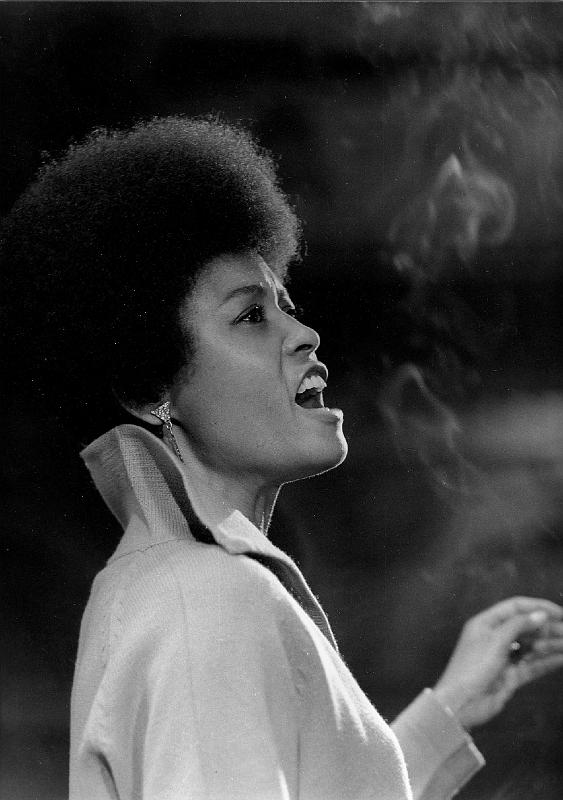
Abbey Lincoln

Today we lost one of the true originals. Abbey Lincoln passed away today in New York. Read Nate Chinen's obituary here. I will let others eulogize her, since I am not terribly well-versed in her work. Still, her early-1960s output included some real gems, beginning with the classic Straight Ahead, but also including her contributions to (then-husband) Max Roach's Freedom Now Suite and Percussion Bitter Sweet. She sang with a fire and passion befitting her era, and was unafraid to assert herself, both as an African American in a country where she did not yet enjoy equal rights and as a woman in a male-dominated jazz world. The world is worse off without her voice, but at least she left us with some brilliant recordings.


Image via Pieter Boersma

15 March 2010

Ides of March


I'll go with the Ph. D. in astrophysics over the dude who may have been a plagiarist. Okay, he probably wrote those plays, but still...
Here is a live recording of the Secret Society playing Zeno at Le Poisson Rouge back in 2008:

20 January 2009

On Booker Little and Jazz Mythology

Booker Little and Clifford Brown had much in common. Both were trumpet players from middling cities (Little from Memphis, Brown from Wilmington, Delaware) who played important roles in the development of jazz trumpet, but died before their thirtieth birthdays. Brown's and Little's solos are both studied and transcribed intently by young trumpet players. Both made impressive albums, both as a leader and a sideman, which are among the greatest jazz on record. Both were sidemen in Max Roach's quintet, and both built on the bebop trumpet style of Dizzy Gillespie and Fats Navarro.

Yet while Clifford Brown has been mythologized in The Jazz Tradition, Little remains a surprisingly obscure figure in the history of jazz, known mostly by musicians and aficionados. Why is this? It can't be because Little did not record enough masterpieces. Take a look at his discography, he appeared on Africa/Brass, Percussion Bitter Sweet, and Eric Dolphy's live recordings at The Five Spot. They may not be the most legendary recordings, but they are just as memorable and important to the development of jazz as any of the best Clifford Brown recordings. I would argue the same of Little's solo work, especially the well-regarded Out Front.

I wish I could come up with a better reason, but it seems to me that the answer largely has to do with timing and circumstance. Brown's heyday fits within a neat break in The Jazz Tradition. His first recording with Max Roach, Brown and Roach, Inc., was recorded in August 1954, just a few months before the death of Charlie Parker. Brown's ascent comes just as a the historical arc of jazz is in need of a protagonist. The same cannot be said for Little. Among his contemporaries were Ornette Coleman and John Coltrane, two figures who seemingly crowd out all other jazz musicians in some writers' retellings of the history of jazz between 1960 and 1963. Little seems to get lost in the background of jazz history.

But Clifford Brown is not just a lead player during one period of The Jazz Tradition, his personal story is also more easily mythologized. Because Charlie Parker's death stemmed from years of drug abuse, the clean cut image of Brown, who shunned drugs, smoking, and drinking, served as important story in jazz. Brown was kind of a corrective to the surprisingly-prevalent notion among jazz musiciansat the time that herion use contributed to creativity and performance (at least, according to some). This factor is also key in transforming Brown's life into myth; he is the opposite kind of fast-burning flame than Parker, and his story serves as a captivating next chapter following Bird's life and death. Ken Burns uses this dichotomy to much effect in his documentary Jazz.

So for having reasons little to do with their own music in some regard, perhaps, Brown can be mythologized into this jazz martyr, while Little is neglected by history. This fact in itself is an interesting critique of the mythologization of jazz inherent in The Jazz Tradition, and should inspire us to think beyond this master narrative when considering the history and development of jazz.


15 January 2009

List: 1959: Before and After

Being that 1959 saw the release of so many landmark jazz albums (Kind of Blue, Time Out, Giant Steps, The Shape of Jazz to Come, etc.), plenty of writers will be profiling the golden jubilees of all these albums throughout the year. But focusing on 1959 misses the point of that era. While 1959 was certainly a great year for jazz, the years surrounding 1959 all created their fair share of classics canonized in The Jazz Tradition. Since the late 1950s and early 1960s were a veritable golden age for jazz, when young lions like Coltrane and Coleman were reshaping the music while older stars like Ellington and Hawkins were still thriving, lets not limit ourselves to remembering 1959 as a watershed moment. Below are some great albums from 1958 and 1960 which are sometimes overshadowed by the weight of 1959.

A quick note: I am classifying these albums by the date they were recorded. Some were released the year after they were recorded, but the way things were changing in the jazz world at this time, a musician could sound much different over the space of a year (such is the case especially with John Coltrane).

1958:
  1. Bill Evans, Everybody Digs Bill Evans. Featuring an interesting album cover, Everybody Digs Bill Evans effectively introduced Evans to the jazz world just as he was to join Miles Davis' quintet at the piano chair.
  2. Cannonball Adderley, Somethin' Else. One of the classic hard bop records, Cannonball was joined by a veritable all-star band featuring Miles Davis, Art Blakey, Hank Jones, and Sam Jones. Adderley firmly established his reputation as a prominent figure in jazz with this record.
  3. Ornette Coleman, Something Else!!!!. One of the few albums in which Coleman used a piano player (Paul Bley in this case), Something Else introduced the world to Coleman before his infamous residency at New York's The Five Spot in 1959.
  4. Miles Davis, Porgy and Bess and Milestones. Porgy and Bess reinforced Miles' image as the biggest star in jazz, selling countless copies, while Milestones set the stage for 1959's Kind of Blue.
  5. Art Blakey & The Jazz Messengers, Moanin'. The title track was, in my estimation, the quintessential hard bop tune, the definitive example of the style I play when trying to explain what hard bop was.
  6. John Coltrane, Blue Train. Hard to believe Blue Note Records only got Coltrane in the studio as a leader once in his life.
  7. Sonny Rollins, Freedom Suite. Some say this is Rollins' best studio album. Hard to argue against that, but the album is also important for the brief liner notes written by Rollins which draw light to the status of African Americans in the land of the free.
1960:
  1. Miles Davis, Sketches of Spain. Though plenty of people will tell you that this is not really a jazz record, it nonetheless introduced jazz to a lot of people over the past five decades. I remember when I bought this album eight years at a music store in Toronto. When I paid for it, the cashier, a guy in a Slayer t-shirt with multiple piercings, simply said to me, "great album." This was not the kind of person you'd expect to make that comment.
  2. John Coltrane, My Favorite Things and Olé Coltrane. While My Favorite Things propelled Coltrane into stardom, Olé Coltrane is an underrated album in the Coltrane canon, featuring a young Freddie Hubbard in addition to the dueling basses of Reggie Workman and Art Davis.
  3. Ornette Coleman, Free Jazz. In which Ornette ups the ante and firmly opens Pandora's Box, cementing the enfant terrible reputation he began to earn with Something Else.
  4. Charles Mingus, Charles Mingus Presents Charles Mingus. The opening track, "Folk Forms No. 1," perfectly fuses the blues with improvised contrapuntal composition, while "Original Faubus Fables" unleashes Mingus' contempt for a segregationist Arkansas Govern0r Orval Faubus.
  5. Art Blakey & The Jazz Messengers, A Night in Tunisia and Roots & Herbs. Featuring one of the best editions of the Messengers (Lee Morgan, Wayne Shorter, Jymie Merritt, and Bobby Timmons), Blakey recorded a lot of albums in 1960. These two are my favorites of the bunch.
  6. Max Roach, We Insist! Max Roach's Freedom Now Suite. Featuring a photo of black college students at a sit-in, Roach's Freedom Now Suite presented a musical history of African Americans, featuring the vocals of Abbey Lincoln.
  7. Wes Montgomery, The Incredible Jazz Guitar of Wes Montgomery. Montgomery lays down some choice hard bop and shows all who care to listen that he is the guitar boss of the jazz community. His version of Airegin is my favorite recording of the Sonny Rollins standard.
UPDATE 1: The lists have already begun. Here's one from acompleteunknown at The Good, The Bad, and The Unknown. They've made some good choices, though I would replace Mingus' Ah Um with Blues and Roots, and would not have left off Giant Steps...

UPDATE 2: Kevin Kniestedt offers his thoughts on 1959 at Groove Notes.

06 December 2008

Under the Radar: Percussion Bitter Sweet

Max Roach
Percussion Bitter Sweet

In the standard history-of-jazz retelling, Max Roach disappears in 1957. He shows up in the 1940s, when he was present at the creation of bebop, and, along with Kenny Clarke and Art Blakey, reinvented jazz drumming for a new generation. He shows up again in the mid-1950s, when he is leading a hard-bop quintet with Sonny Rollins and Clifford Brown that helps define the genre. Beyond that, he fades against the luminaries of Ornette Coleman, Miles Davis, John Coltrane, and others. Max Roach seemingly ceases to be a titan of jazz, slipping into historical obscurity.

In reality, while operating under the massive shadows cast by Ornette Coleman, John Coltrane, Miles Davis, and others during the 1960s, Max Roach produced some wonderful jazz in the early part of the decade worth revisiting. Though he would later recede from the jazz community,* his work early in the decade displayed an artist whose social activism reinvigorated his art following the tragic death of Clifford Brown in 1956. Roach thrust himself into the burgeoning civil rights movement during the late 1950s, raising money for various civil rights organizations, taking part in protests and sit-ins, and using his position as a professional musician to promote the cause in the media. His activism first seeped into his music with 1958's Deeds, Not Words, though one could argue that his founding of Debut Records with Charles Mingus in the early-1950s was also part of his activist streak, considering the socioeconomic environment in which musicians operated.

Roach's activism flourished as the 1960s began. In 1960, Roach helped organize a rebel counter-festival at the Newport Jazz Festival, hoping to promote younger up-and-coming musicians while protesting the low pay of the (usually black) artists who could not garner top billing. Later that year, Roach recorded We Insist! Max Roach's Freedom Now Suite, a multi-part work which chronicled the history of African Americans from slavery to 1960. The next year, Roach would record Percussion Bitter Sweet, with a veritable all-star lineup including trumpeter Booker Little, saxophonist Eric Dolphy, vocalist (and wife) Abbey Lincoln, and pianist Mal Waldron, among others. The album features fresh rhythms, incorporating Afro-Cuban 6/8 beats at times, and captivating performances, but it was also a statement of Roach's cultural politics. Roach acknowledges jazz as rooted in African rhythms and folkways, and presents music that is informed by and informing of African cultures and societies.

The album opens with "Garvey's Ghost," early-20th century black nationalist Marcus Garvey. After a haunting opening melody, Little gives a searing, melodic solo. Little plays around the harmony, weaving in and out of pitch in a solo evocative of a strong orator, rising in energy as his speech builds momentum. Clifford Jordan follows with a wide-ranging solo, and Roach then gives a playful and exploratory drum solo over a conga and cowbell accompaniment. The song closes with the restatement of the melody. Written by Roach, "Garvey's Ghost" uses Lincoln's voice in a chorale with the winds, lending added power to the melody. It is a wonderful example of inter-genre fusion, sounding at home in Africa and America, but possible only in the context of jazz.


"Tender Warrior" reminds us how special Booker Little and Eric Dolphy, and gives the listener pass to wonder how jazz would have been different had both of them not died too young. Little carries the tunes main melody on his flute, showing captivating control over the instrument and letting his voice sound through it. Mal Waldron gives an imaginative solo, followed by Little, who toes the line between harmony and dissonance better than any of his peers could at the time, providing a bridge between hard bop and the avant-garde. Besides that, his sound is wonderful, combining the urgency of Clifford Brown with the vocal quality and warmth of Miles Davis. Dolphy goes on flights of fury on a bass clarinet, followed by an even more furious drum solo by Roach. However, being Max, even when playing furiously he exhibits amazing control over the kit, not making any extraneous sound to dull his lines.


Perhaps the irony of Max Roach is that he made some of the best socially-conscious jazz ever, but did so at a time when highly artistic jazz was en vogue. This is not to say that the two are mutually inclusive, or that they are in direct opposition. Rather, Roach reached one of his peaks during the early 1960's when he recorded Percussion Bittersweet and Freedom Now Suite. However great those albums were, the public and jazz press at large were more interested in (or repulsed by, and then mobilized against) the zeitgeist created by Coleman and pushed further by Coltrane, Albert Ayler, et al. Thus, Roach is under-appreciated in memory, and a fertile period of work for him is not as well-remembered as his earlier peaks or the simultaneous peaks of his peers. Such is jazz, a diverse music that has become nearly impossible to completely keep up with.

Track Listing: Garvey's Ghost; Mama; Tender Warriors; Praise for a Martyr; Mendacity; Man From South Africa
Personnel: Max Roach, drums; Booker Little, trumpet; Julian Priester, trombone; Eric Dolphy, reeds; Clifford Jordan, tenor saxophone; Mal Waldron, piano; Art Davis, bass; Carlos "Patato" Valdes, conga; Carlos "Totico" Eugenio, cowbell; Abbey Lincoln, vocals

*A few resources I read while composing this post (including Roach's biography at All About Jazz), reference a brief period during the mid to late-1960s when Roach was "blacklisted by the American recording industry." The language in these references is vague, and offers few added details. I had not previously seen this in any other readings I have done, which leads me to be somewhat suspicious of the claim. Previously, I had understood that Roach scaled back during this time, recording less often because he was focused on his activism at the time. I'll have to get back to you on that one...

Stats