Via Kottke, above is a radio interview of Louis Armstrong from 1964, with commentary from the (then-) teenage interviewers. It's worth your five minutes.
Interviewed by Michael Aisner and James R. Stein in 1964, originally aired on WNTH in Winnetka, Illinois
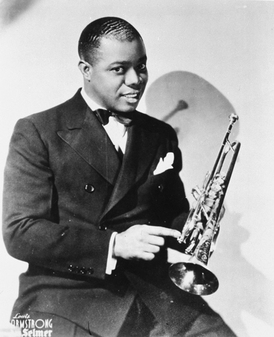
Louis Armstrong died 39 years ago today. Shortly after Armstrong died, Dizzy Gillespie penned this obituary for Satchmo (click to enlarge).
Never before in the history of black music had one individual so completely dominated an art form as the Master, Daniel Louis Armstrong. His style was equally copied by saxophonists, trumpet players, pianists and all of the instrumentalists who make up the jazz picture.
One of the significant factors in his art was the ability to sing exactly as he played. Before Louis, too, the role of the trumpet was to lead. He established the trumpet as a solo instrument. The distinctive quality in his style was POWER. He was known to have hit hundreds of high C's, one after the other, each with the same level, and to end on a high F or G. This was unheard of before. His melodic concept was as near perfect as possible, his rhythm impeccable. And his humor brought joy into the lives of literally millions of people, both black and white, rich and poor.
When the State Department sent me on a cultural mission to Eastern Europe, the Middle East and South America in 1956, the band did a musical history of the various innovations that had been created in our music. Needless to say, Louis was prominently displayed.
Louis is not dead, for his music is and will remain in the hearts and minds of countless millions of the world's peoples, and in the playing of hundreds of thousands of musicians who have come under his influence.
I'm off on a mini-vacation to the Eastern shore of Maryland this weekend. I'll be seeing you again next week. In the meantime, drink up, eat well, and remember to celebrate the paterfamilias:
Via the indispensable Uni Watch Blog, below is a photo of Louis Armstrong's baseball team, Armstrong's Secret Nine. I would love to get my hands on one of those jerseys, as well as the sweet striped stirrups. Only 246 shopping days left until Christmas...
Also to be reviewed soon, Robin Kelley's exhaustive new Thelonious Monk biography. I would review it sooner, but I'm taking my time with the book and enjoying it. In the meantime, Kelley was a guest on NPR's On Point last month.
Tonight PBS will reair last week's Kennedy Center Mark Twain Prize American Humor ceremony, awarded to Bill Cosby. While Cosby received the prize for his contributions to comedy, he will also be acknowledged as a longtime advocate for jazz, with musicians Wynton Marsalis and Jimmy Heath appearing at the ceremony. Cosby has hosted the Playboy Jazz Festival in Los Angeles every year since 1979, and has appeared on a number of jazz albums, including Charles Mingus And Friends In Concert, a favorite of mine.
Below, Cosby ruminates on Lester Bowie and Louis Armstrong on the set of The Cosby Show.
Even though it's long been established that he wasn't actually born on the 4th of July, I always think of Louis Armstrong on the 4th (nothing wrong with a little mythologizing on a holiday). So happy birthday, Louis.
As a budding trumpet player in high school, I listened to a ton of trumpet solos. One of the most rudimentary steps in developing your own style as a jazz musician is to listen to as many other musicians as possible and transcribe their solos. By doing so, you improve your own ear and give yourself somewhat of a stylistic guide that serves as a jumping off point for your own voice. Below is a list of eight trumpet solos which any young musician would do well to transcribe. Some of the choices are rather obvious, and others (hopefully) are not as obvious. Feel free to let me know what I missed in the comments, the list is not meant as the be-all-end-all of jazz trumpet, but merely a starting point. The list is in relatively chronological order.
Louis Armstrong, Wild Man Blues, from The Complete Hot Five and Hot Seven Recordings: West End Blues gets all the attention for its divine opening cadenza, but I always preferred Wild Man Blues. Armstrong remains important to modern trumpet players both for his swagger and humanity, and he packs an abundance of both into this solo.
Dizzy Gillespie, Shaw 'nuff, on many compilations: Dizzy opened up new worlds for trumpet players, and his solos represent a primer on improvisation for young trumpet players. His work is an important building block for modern jazz trumpet improvisation.
Miles Davis, Now's The Time, from almost any Charlie Parkercompilation: Certainly there are many important Miles solos to choose from, but I find that learning this solo tends to wean trumpet players off of the habit of playing lots of fast runs and high notes, and gets them to concentrate on melody as well as rhythm and harmony. Miles showed trumpet players during the 1940s that they did not have to play like Dizzy in order to make good jazz, a lesson which is still important.
Lee Morgan, Moanin', from Moanin': This is one of the more obvious choices on the list, but there is a reason for that. Morgan distills the entirety of hard bop into this solo, it swings violently, is drenched in the blues, but also reveals a harmonic sophistication that separated the wheat from the chaff of the genre. I could listen to this solo every day for the rest of my life and not get tired of hearing it. This solo is a necessary primer on hard bop for any young musician, trumpet player or not.
Booker Little, Garvey's Ghost from Percussion Bitter Sweet: Little plays outside the melody and around the changes, giving a new perspective on improvisation that bridges hard bop and free jazz.
Freddie Hubbard, "One Finger Snap," from Empyrean Isles:This is my favorite Hubbard solo. Hubbard had incredible chops, which makes transcribing his solos a physical as well as mental challenge. He compels you to improve your technique.
Wynton Marsalis, Caravan from Marsalis Standard Time ~ Vol.1: Wynton synthesizes a sizable chunk of jazz history in his earlier work, giving a good intro to neobop improvisation.
Now, even considering the fact that there are no solos by Clifford Brown, I think this is a decent place to start. What would you add to or subtract from this list?




 , a favorite of mine.

 : Dizzy opened up new worlds for trumpet players, and his solos represent a primer on improvisation for young trumpet players. His work is an important building block for modern jazz trumpet improvisation.
 :
:

 : Wynton synthesizes a sizable chunk of jazz history in his earlier work, giving a good intro to neobop improvisation.

