18 July 2009

Review: Infernal Machines

Darcy James Argue's Secret Society
I'm a bit late to Darcy James Argue's party, so I'll be brief. Argue, a heretofore relatively obscure composer and bandleader in New York, just released his debut album, a big band project which evokes both the lofty atmospherics of the Maria Schneider Orchestra and the sounds of modern indie rock. Argue recently wrote of his music:
What if the big band had remained the standard vehicle for popular music? What if every time you turned on the radio, everyone from T-Pain to Rihanna to Katy Perry was backed by a big band? What if Animal Collective and Vampire Weekend and MGMT all had 13-piece horn sections? What if the Rock Band video game came with a whole bunch of trumpet and saxophone and trombone controllers? I am not saying this would necessarily be a desirable situation. But it is fun to think about. At least, it’s fun for me to think about. And my music for Secret Society essentially comes out of me imagining what a jazz big band would sound like in an alternate reality where big bands were still widely popular (instead of a curious anachronism), and where jazz was still on speaking terms with other musical genres.
Judging from the sizable audience for his blog, as well as the many enthusiastic reviews of the album, it appears Argue is not the only person who thinks this would be fun to think about. Argue delivers the goods on the album, to boot. The opening track, Phobos, layers flowing wind orchestrations over an intense guitar line in a way that weds Gil Evans and late-period Led Zeppelin. Transit is another highlight, a bona fide barnburner featuring an excellent solo from trumpeter Ingrid Jensen.

Argue might not change the trajectory of jazz, but he nonetheless offers a refreshing reinvention of the big band form. I can't wait to hear what he comes up with next. Those unfamiliar to Argue's work are recommended to check out his blog and website, where you can download free live recordings of the Secret Society, and his record label, New Amsterdam Records, where you can stream the album and anything else in their catalogue.


Track Listing: Phobos, Zeno, Transit, Redeye, Jacobin Club, Habeas Corpus (for Maher Arar), Obsidian Flow

Do this for the next 30 minutes

Courtesy of Jazz Video Guy Bret Primack, here is the late pianist Walter Bishop Jr. discussing his Theory of Fourths. It is a bit dense for nonmusicians, but nonetheless an interesting discussion of music theory. Thanks, Bret!


h/t @jazzvideoguy

17 July 2009

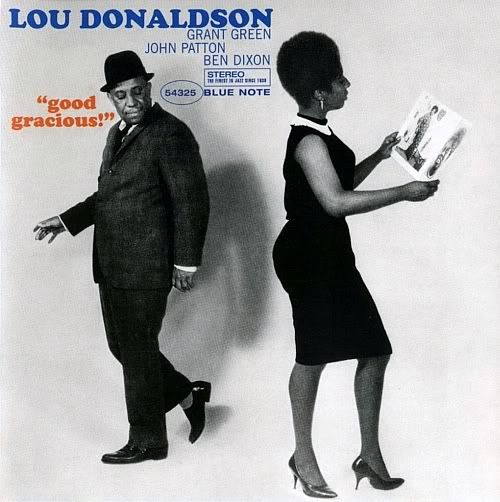
Good Gracious

From If Charlie Parker Was a Gunslinger, There'd Be a Whole Lot of Dead Copycats comes this Blue Note cover for Lou Donaldson, who wasn't concerned with the world knowing he was a lecherous creep. Such were the early 1960s...

In other corners of the jazz blogosphere:

13 July 2009

JazzTimes Lives

In an interview over the weekend, JazzTimes editor-in-chief Lee Mergner said the magazine will resume publication in August. Former publisher Glenn Sabin sold the magazine to Madavor Media. According to Mergner, the magazine will retain much of its editorial staff and contributors, and will not clean house. I'm looking forward to receiving the August issue, and perhaps I can finally get that Horace Silver DVD they owe me for my subscription gift...

12 July 2009

Review: Spirit Moves

Dave Douglas
Spirit Moves

Dave Douglas is no stranger to what might be termed (for lack of a better word) "tribute albums," having recorded albums featuring the music of Booker Little and Mary Lou Williams, among others (In Our Lifetime and Soul on Soul, respectively). What makes his tributes unique, though, is that rather than reinterpreting the work of another musician, Douglas prefers to filter the tribute subject's style through his own, in an effort to recreate that subject's sound and persona in a new context. Thus, his "tributes" counterintuitively consist mostly of original material. On his latest album, Spirit Moves, Douglas is again playing with a number of influences in mind, in this case the early-20th century New Orleans brass bands that played a role in the creation of jazz as well as Lester Bowie's Brass Fantasy band, which used the brass ensemble as a vehicle for performing all sorts of music, from pop to classical and many points between. Douglas performs here in a brass quartet accompanied by drummer Nasheet Waits.

The music on this album ranges from moments of tightly arranged composition to free-wheeling group improvisation, with Douglas and trombonist Luis Bonilla shouldering a bulk of the soloing duties. The repertoire is similarly varied. The opening track, This Love Affair, features an Eastern European tinge reminiscent of Douglas' Tiny Bell Trio, while Bowie hearkens back to the aforementioned turn-of-the-century New Orleans brass band. Douglas is in high form throughout, consolidating the trademark smears and half-valve effects favored by Bowie into his own thoroughly modern sounds. His arrangements are thoughtful and colorful, taking advantage of the almost limitless sounds made possible by the blending of different brass instruments. This Love Affair uses an oom-pah pattern between the tuba and a combination of French horn and trombone which creates a wonderfully dark backdrop for Douglas' dirge-like lamentations on trumpet.


However, periodically the band reveals why the conventional jazz ensemble evolved without the tuba, opting for the upright bass instead. On tunes like The View From Blue Mountain, in which the tuba provides the rhythmic drive, the band feels somewhat stiff, and I am left wondering if the tune would sound better with a bass instead of the tuba. Anyone who's played a tuba before can attest to the difficulties inherent in playing the types of bass lines Douglas writes on this album. Luckily, though, Douglas included Nasheet Waits, a regular of Jason Moran's trio, on drums for the album. Waits provides a propulsive lightness which often counteracts any moments of excess heaviness in the tuba.

This album might slip through the cracks when it comes time for year-end lists and awards. While it is decidedly unconventional, the album breaks little new ground and might not stand out for any other reason than its unusual instrumentation. However, there are few better ways to spend an afternoon than listening to Douglas' various takes on the history of jazz. For that, this album provides great fodder. You won't be disappointed.


BONUS: Greenleaf Music has posted some studio footage of the band playing The View From Blue Mountain.


Track Listing: This Love Affair; Orujo; The View from Blue Mountain; Twilight of the Dogs; Bowie; Rava; Fats; The Brass Ring; Mister Pitiful; Great Awakening; I'm So Lonesome I Could
Personnel: Dave Douglas, trumpet; Vincent Chancey, French horn; Luis Bonilla, trombone; Marcus Rojas, tuba; Nasheet Waits, drums

Stats