07 July 2009

How Not To Write Jazz Criticism

I'm a bit late to the party, but perhaps you've heard about this review of the Maria Schneider Orchestra's recent performance at the Ottawa Jazz Festival. It has everything jazz critics should avoid: including blatant misogyny, focusing on the histrionics of the performance instead of the actual music, and disdain for other members of the audience. Needless to say, it sparked a good deal of criticism from commenters at the Montreal Gazette (who published the review) and jazz bloggers.

James Hale said it best: "So, on behalf of professional jazz journalists everywhere: Thanks, Jeff. You just set back our cause beyond measure." At Rifftides, Doug Ramsey adds:
As jazz magazines go out of business and coverage budgets at general circulation publications dry up, one part of conventional journalism wisdom is that the web, specifically bloggers on the web, will take up the slack. Please don't let it disturb you if I point out that most bloggers work for nothing more than the challenge, the thrill, the contacts or the loss-leading benefits of using their blogs as adjuncts to whatever they do for a living. It would be a mistake to count on them (us) to provide the standards and oversight that print publishers are unwilling or unable to observe and practice. In journalism as in the rest of life, generally you get what you pay for.
I can't say I totally share Doug's pessimism. Bloggers (especially in the realms of sports and politics) have become notorious for their reputations as curmudgeonly spewers of invective and poor (and often absent) fact-checking (whether or not they deserve these reputations is another argument altogether that I will avoid here). However, being that jazz occupies a niche space in our culture, it seems to me that most jazz bloggers write mostly out of their love for the music. While this does not guarantee that dreck such as this Heinrich review will not appear from time to time, I like to think (perhaps too optimistically) that these bloggers-cum-enthusiasts will tend to govern themselves according to the standards of civility to which conventional journalists are held by their editors.

Meanwhile, this criticism of big band jazz made the rounds last week. I'll defer to Darcy James Argue and Ian of Villes Ville on their rebuttals to the piece; they defend big band jazz with passion and more effectively than I could hope to. Besides, I mention it here not to criticize Matt Rubin, the writer of the post, but rather point out that while his argument is critical, he does not resort to the nastiness of Heinrich's piece. He keeps a level head and stays focused on the music, in the way that I think most jazz bloggers (who actually care about jazz) would.

Lastly, I beg of you, my readers: please do not hesitate to put me in my place if I ever write something so terrible as Heinrich's takedown of Maria Schneider.

Now, in order for us all to cool off, let's watch a YouTube of Charles Lloyd with John Abercrombie, Marc Johnson, and Billy Hart.


04 July 2009

Thinking of Louis

Even though it's long been established that he wasn't actually born on the 4th of July, I always think of Louis Armstrong on the 4th (nothing wrong with a little mythologizing on a holiday). So happy birthday, Louis.


03 July 2009

Must Read

In The Weekly Standard, Joe Queenan tells a tale of former Federal Reserve Chairman Alan Greenspan's days as a jazz musician. Some choice quotes follow. Greenspan brought a distinctive approach to improvisation, as told by Snooky Parnell:
"The Green Man [his nickname at the time] always played his arpeggios back to front, and in the subtonic key, which forced the listener to rethink his assumptions about where a solo should go," recalls Parnell, who played bass with Miles Davis, Art Tatum, and Thelonious Monk.
He also played well enough to impress Charles Mingus, who invited Greenspan to tour Europe with his octet after sitting in one night in San Francisco. But Greenspan could not handle the thought of not being the best saxophonist around, an insecurity which eventually led him to quit the music business:
It was September 14, 1949, and Greenspan found himself in the same Greenwich Village club as John Coltrane. Coltrane, a convivial sort, went out of his way to be friendly to the youngster, but Greenspan was having none of it. Sax at the ready, he challenged Coltrane to an onstage showdown. It was a mistake he would regret for the rest of his life.

"Trane smoked his ass," Parnell remembers. "Greenie foolishly tore into 'Cherokee,' Charlie Barnet's old standby, but Trane knew that tune inside out from his days in Kansas City. Greenie tried to keep up, but no chance. Trane didn't rile easily, but something about the way Greenie carried himself didn't suit John. Trane took him apart."

Read the full piece here.


h/t: jazz.com

02 July 2009

Review: Folk Art

Joe Lovano Us Five
Folk Art
On his newest album, Joe Lovano exhibits the adventurousness you would expect from someone who plays regularly with Paul Motian. Pianist James Weidman also stars here, soloing provocatively and banging out chords while comping in a manner evocative of McCoy Tyner. And bassist Esperanza Spaulding lays down an impressive foundation ornamented by dual drummers Francisco Mela and Otis Brown III. If he keeps this band together, it could quickly become one of the best working groups in jazz. Take a listen to the interplay on "Us Five."


At the risk of repeating myself, one of my favorite aspects of Joe Lovano's style is his luscious tone, which he derives as much from pre-Coltrane saxophonists like Don Byas and Coleman Hawkins as the usual influences. This alone makes checking him out worth it, but there is of course so much more to Lovano than his tone. He is a perhaps underrated titan of postmodern jazz, whose musical personality demands your attention.

Extra Credit: Jazz Video Guy Bret Primack gets a behind-the-scenes look at Lovano's quintet before a performance at the Village Vanguard.


Track Listing: Powerhouse; Folk Art; Wild Beauty; Us Five; Song for Judi; Drum Song; Dibango; Page 4; Ettenro
Personnel: Joe Lovano, saxophone; James Weidman, piano; Esperanza Spaulding, bass; Francisco Mela, Otis Brown III, drums

22 June 2009

Race Relations, 50 Years Later

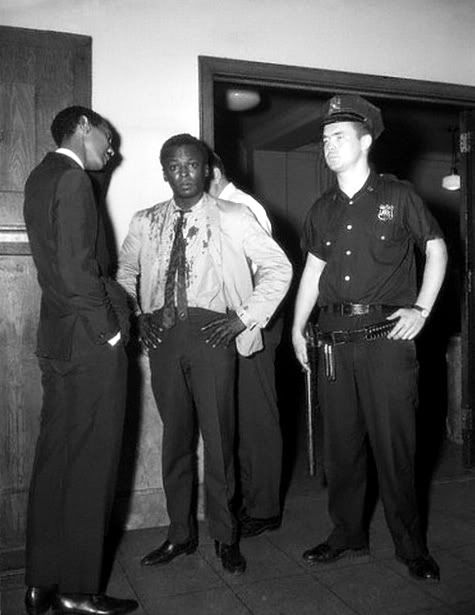
If Charlie Parker Was a Gunslinger ran this photo of Miles Davis a few days ago with the accompanying newspaper caption:
Musician Arrested.

New York -- Miles Davis, 32, of 881 10th Avenue, a trumpeter now appearing in Birdland, 52nd Street and Broadway, was arrested after fighting with patrolman Gerald Kilduff, who had ordered him to move from crowded sidewalk. In the scuffle, Davis was hit on the head with a blackjack for which a St. Clare's ambulance had to be called. (1959)
Of course, in his autobiography, Miles remembered it differently:
I had just finished doing an Armed Forces Day broadcast, you know, Voice of America and all that bullshit. I had just walked this pretty white girl named Judy out to get a cab. She got in the cab, and I'm standing there in front of Birdland wringing wet because it's a hot, steaming, muggy night in August. This white policeman comes up to me and tells me to move on. At the time I was doing a lot of boxing, so I thought to myself, I ought to hit this motherfucker because I knew what he was doing. But instead I said, "Move on, for what? I'm working downstairs. That's my name up there, Miles Davis," and I pointed to my name on the marquee all up in lights.

He said, "I don't care where you work, I said move on! If you don't move on I'm going to arrest you."

I just looked at his face real straight and hard, and I didn't move. Then he said, "You're under arrest!" He reached for his handcuffs, but he was stepping back. Now, boxers had told me that if a guy's going to hit you, if you walk toward him you can see what's happening. I saw by the way he was handling himself that the policeman was an ex-fighter. So I kind of leaned in closer because I wasn't going to give him no distance so he could hit me on the head He stumbled, and all his stuff fell on the sidewalk, and I thought to myself, Oh, shit, they're going to think that I fucked with him or something. I'm waiting for him to put the handcuffs, on, because all his stuff is on the ground and shit. Then I move closer so he won't be able to fuck me up. A crowd had gathered all of a sudden from out of nowhere, and this white detective runs in and BAM! hits me on the head. I never saw him coming. Blood was running down the khaki suit I had on. Then I remember Dorothy Kilgallen coming outside with this horrible look on her face--I had known Dorothy for years and I used to date her good friend Jean Bock--and saying, "Miles, what happened?" I couldn't say nothing. Illinois Jacquet was there, too.

It was almost a race riot, so the police got scared and hurried up and got my ass out of there and took me to the 54th Precinct, where they took pictures of me bleeding and shit. So, I'm sitting there, madder than a motherfucker, right? And they're saying to me in the station, "So you're the wiseguy, huh?" Then they'd bump up against me, you know, try to get me mad so they could probably knock me upside my head again. I'm just sitting there, taking it all in, watching every move they make.
Miles adds, "I would have expected this kind of bullshit about resisting arrest and all [for which he was charged that night] back in East St. Louis (before the city went all black), but not here in New York City, which is supposed to be the slickest, hippest city in the world." For all America's ills, at least some things have changed for the better. On with this month's links.
  • Fresh off the folding of Jazz Times, Nate Chinen's regular column at the magazine, The Gig, has moved over to his new blog of the same name. Here he discusses the jazz influences of indie rock stars Grizzly Bear.
  • Michael Katzif at A Blog Supreme interviews Icons Among Us director Michael Rivoira.
  • Black Classical has released a tribute to Blue Note Records: a huge mix featuring Blue Note tracks from Andrew Hill, Bobby Hutcherson, Wayne Shorter, Jackie McLean, and more. Check it out, it is worth a listen.
  • Don Heckman interviews Jimmy Cobb on the anniversary of Kind of Blue.
  • At Rifftides, Doug Ramsey reiterates what everyone should know: Late-period Ellington is among some of the best music ever recorded.
  • Stephan Mejias takes a look at the latest reissue of Spiritual Unity.
  • Jazz.com has a wide-ranging interview with Jack DeJohnette.
  • Here is a snippet of Charles Mingus' Remember Rockefeller at Aticca (context):

Stats