11 August 2009

Review: That's Gonna Leave a Mark

Matt Wilson Quartet
Jazz and historical scholarship share a similar pathological obsession with the new. Historians are rewarded more for writing something new than writing something well. I read more than a few books in grad school in which noted scholars and sharp minds stretched an idea far past the point of usefulness in order to make a book-length argument that had never been made before (not naming names...). Meanwhile, there seems to be a scarcity of syntheses which may not be earth-shattering but nonetheless incorporate miscellaneous ideas from other works into a coherent, convincing final product.

Such is the case in jazz. Consider this critique of Wynton Marsalis from Destination: Out!
There was something intractably stodgy about much of this neo-traditional work, lacking both the spark found in the original forms and the thrilling innovations of the so-called avant garde. To our ears, it was minor music with a major publicist.
I'm not begrudging the argument, because I kind of feel the same way. Whenever I listen to Black Codes (From the Underground), I usually end up switching to Miles Smiles before I finish the album. But is my haste to go directly to the source, as it were, indicative of a bias towards music that was "newer" at the moment of creation?

This is where Matt Wilson comes in. His latest album, That's Gonna Leave a Mark, might not be striving to break new ground, but it presents a coherent take on postbop, drawing from the influence of Ornette Coleman's first quartet. Wilson's drumming has been compared to that of Billy Higgins, which I find to be an apt comparison. The tunes on this album are loose and a bit freewheeling, but he anchors the group in a subtle way reminiscent of Higgins' work with Coleman.

Altoist Andrew D'Angelo provides two originals on the album, Shooshabuster and Rear Control, which are among the most intriguing moments of the disc. D'Angelo's compositions are quirky and energetic, with the kind of out-of-the-box thinking that I love when applied to jazz composition. Listen to Rear Control (below); the fusion of the melody and bass line in the A section is a perfect marriage of melody, harmony, and rhythm (you may even call it harmolodic if you knew what you were talking about).


This album likely will not make any top ten lists at the end of the year, and there's a good chance that it will recede into the dark recesses of my music library after awhile, but it is nonetheless a fun listen that shouldn't be put down because it doesn't say anything new.


Bonus Material:


Track Listing: Shooshabuster; Arts & Crafts; Rear Control; Getting Friendly; Two Bass Hit; Area Man; Lucky; That's Gonna Leave a Mark; Celibate Oriole; Come and Find The Quiet Center; Why Can't We Be Friends
Personnel: Andrew D'Angelo, alto saxophone, bass clarinet; Jeff Lederer, tenor saxophone, soprano saxophone, clarinet; Chris Lightcap, bass; Matt Wilson, drums

09 August 2009

A Suggestion for Expanding the Audience for Jazz

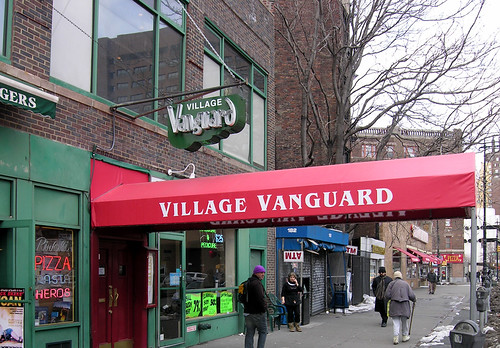
Could jazz clubs like the Village Vanguard be holding back the audience for jazz?

There has been much recent chatter in the blogosphere on the declining audience for jazz. In the Wall Street Journal this weekend, Terry Teachout points out that in the process of becoming a self-conscious art music during the middle of the twentieth century, jazz music became no longer "capable of appealing to the same kind of mass audience that thrilled to the big bands of the swing era." Peter Hum investigated a number of approaches to expanding the jazz audience on Thursday, including hybridizing jazz with other musical forms (an approach which yielded mixed results during the 1970s), promoting younger artists more heavily, and getting John Scofield into the next guitar hero game (which I think would be a great idea regardless of the implications on the audience of jazz). At A Blog Supreme, Patrick Jarenwattananon notes that attendance at all "high-cultural activity" is down (likely due in part to the economic crisis), but is nonetheless troubled by the shrinking audience.

I think jazz musicians can take a lesson from alternative comedy in expanding the audience. In the wake of the comedy boom of the 1980s, a number of comedians like David Cross, Janeane Garafolo, and Patton Oswalt began looking for new venues for stand-up. The idea was to perform where their audience would already be, rather than pulling their fans into the already-established network of comedy clubs. As Nathan Rabin of the AV Club put it, "Fans of Comedians mainstays Patton Oswalt and Zack Galifianakis are more likely to check out an indie band at The Troubadour than shell out $40 to see a Tonight Show regular play SeƱor Ha Ha's Laughatarium." So why not follow your fans to their native setting?

While this movement initially grew out of Los Angeles, alternative comedy scenes also began to flourish in Seattle, New York, Chicago, and a number of other cities. What is important to remember, though, is that instead of altering their acts to make them more palatable to younger audiences, these comics simply brought there acts to venues where young people who would otherwise like their material would go to see a comedy show.

I do not know if the "answer" to jazz's audience question will be to move performances to indie rock clubs (though some performers, like The Bad Plus and Medeski Martin & Wood, already play a number of gigs each year at these kinds of venues), but I am certain that the current jazz club paradigm repels a good number of people from live jazz. The club itself is a good atmosphere for jazz; small and intimate, enabling a personal connection between artist and audience. But it is not everyone's ideal. This is not a new criticism. Jazz clubs are expensive (one night I saw Kenny Garrett in Miami at the now-defunct Arturo Sandoval's Jazz Cafe, and paid a $30 cover with a two-drink minimum on top of that - and those two drinks were not cheap). Compare that to an indie-rock venue, where you can see a good band for $20 (and the beer is cheaper).

The 9:30 Club in Washington, DC, where you can see Son Volt, Mos Def, Janeane Garafolo, and The Bad Plus.

Jazz clubs are also not mixed-use. Most people listen to a variety of genres, and are more likely to attend shows at the same venue if it offers an eclectic range of performances. Jazz clubs, while housing a diversity of jazz artists, largely stick to jazz, which may limit the marketing possibilities for jazz. The 9:30 Club in Washington, DC, hosts a variety of acts ranging from hip hop to indie rock to standup comedy, as well as numerous points in between. It would seem like an advantage for the club itself to draw from diverse fanbases, and that at least a small part of the audience from a Mos Def show might be interested in seeing a jazz act at the same venue if they saw some promotional material (posters, flyers, etc.) for that act while at the Mos Def show (I believe the marketing term for this is cross-promotion).

Maybe we won't see thousands of budding young jazz fans flowing out from mixed-use venues like these, but it certainly would not hurt to try and expand the live-music model, which is limited mostly to jazz clubs and summer festivals. Jazz musicians may not reap the same rewards that alternative comics found, but they cannot wait around for their audience to find them, they must seek them out personally.

UPDATE: Howard Mandel thinks Teachout doth protest too much, while Jason Parker is onto something.


Vanguard photo via Professor Bop's flickrstream, 9:30 Club photo via Excess Void.

30 July 2009

Recent Reading

I recently finished Scott DeVeaux's magisterial history of bebop, and enjoyed it as much as I had any other book of jazz history. DeVeaux thoroughly traces multiple threads which led to the development of bebop, covering such diverse territories as the economics of leading a swing band in the late-1930s and the social world of the after-hours jam session (where bebop was born, according to the creation myth). In addition, he provides sound musical analysis, meticulously cataloging the stylistic changes taking place in jazz during the early-1940s that led to bebop.

However, DeVeaux's greatest contribution in The Birth of Bebop is his account of how jazz began to be transformed from a social dance music, to be enjoyed in large crowds at dances and ballrooms, to an intellectualized art music, to be digested but not danced to. This metamorphosis does not end at the completion of DeVeaux's book, but many of the important first steps that would propel jazz into the art world (and lead to its irrelevance, some might argue) take place precisely at the same time that bebop is blossoming, and not by accident. There are not many books out there right now which would better inform your understanding of how jazz got to where it is today than The Birth of Bebop.


Why does the trumpet loom so large in the history of jazz? This question is at the heart of Krin Gabbard's new cultural history of jazz. Gabbard reaches back as far as ancient history for clues as to why young black men like Buddy Bolden and Louis Armstrong picked up the trumpet after the turn of the century and presented a statement of African American humanity and masculinity.

Gabbard also tells a personal story of the trumpet, discussing his own reunion with trumpet playing to give the reader a look into the nuts and bolts of trumpet playing. His discussion of the evolution of the trumpet, visits to trumpet manufacturers, and recollection of his struggles with the instrument give a broader view of the trumpet, by fleshing out the physical demands it places on its practitioners. Gabbard does not say anything that is particularly earth-shattering in this book, but his decision to trace the history of jazz through the trumpet provides a coherent framework for understanding some of the social forces which contributed to the development of jazz.

28 July 2009

George Russell

George Russell (r) with John Coltrane, via GeorgeRussell.com

Sad news this morning as the pianist, educator, and music theorist George Russell died Monday from complications from Alzheimer's disease. Russell's treatise on modal improvisation, The Lydian Chromatic Concept of Tonal Organization, published in 1953, provided the theoretical basis for the modal jazz of Miles Davis and John Coltrane. While he is perhaps best known for The Lydian Chromatic Concept, he was an important composer and musician in his own right, having written the Dizzy Gillespie classic Cubana Be Cubana Bop and led countless bands himself. If you have not checked out Ezz-Thetics, his 1961 album featuring Don Ellis, Eric Dolphy, and Steve Swallow, then do yourself a favor and buy it now.

Below is some audio and video of Russell for your listening pleasure...

The Jazz Video Guy brings us an an excerpt from the 1958 tv program, "The Subject is Jazz," featuring George Russell's composition and arrangement, "Stratusphunk," with Bill Evans on piano, Art Farmer, trumpet, Jimmy Cleveland, trombone, Gene Quill, alto, Ed Thigpen, drums:


An excerpt of Dizzy Gillespie's big band playing Cubano Be Cubano Bop in 1947:

Cubana Be - Dizzy Gillespie

George Russell discusses the music of Ornette Coleman with Coleman and Robert Palmer:


Also no longer with us is Merce Cunningham, the modernist choreographer. Be sure to read Ethan Iverson's brief remembrance, you'll be glad you did.

Stats